
Most real estate agents in 2026 are still trying to market to everyone. They post generic content, run broad ads, and wonder why their pipeline feels like a revolving door of mismatched leads. The truth is that a real estate target market is not something you stumble into. It is something you define on purpose. When you get specific about who you serve, your messaging gets sharper, your marketing costs drop, and the clients who do find you are the ones you actually want to work with. This guide walks you through a four-step process for identifying, reaching, and speaking directly to your ideal real estate audience, so you can stop wasting energy on people who were never going to hire you in the first place.
Find It Fast
Key takeaways
- Start by analyzing your existing client base to find patterns in demographics, geography, psychographics, and transaction behavior before you build any marketing campaign.
- Look for market gaps that align with your existing strengths, not just trending topics that sound interesting.
- Match your messaging to specific audience personas: first-time buyers need clarity and reassurance, luxury sellers respond to data and results, and investors want numbers and speed.
- Choose marketing channels based on where your target audience actually spends time, not where you feel most comfortable posting.
- Track engagement and conversion data monthly and adjust your approach based on what the numbers show, not what you assume.
- Defining a specific real estate target market is not about excluding clients. It is about attracting the right ones with less effort and lower cost.
Why broad targeting fails in 2026
If you have already recognized the importance of knowing your audience in real estate, this article is the next step. It moves past the “why” and into the “how.” Specifically, you will learn a four-part process:
- Reflect on past clients to uncover patterns and preferences.
- Spot untapped market opportunities that align with your strengths.
- Craft messaging that speaks to specific audience segments.
- Choose the most effective marketing channels based on audience behavior.
The agents who struggle most with marketing in 2026 are not the ones with bad content. They are the ones with no clarity about who their content is for. When you try to speak to everyone, you end up resonating with no one. This process fixes that.
Rewrite your brand strategy
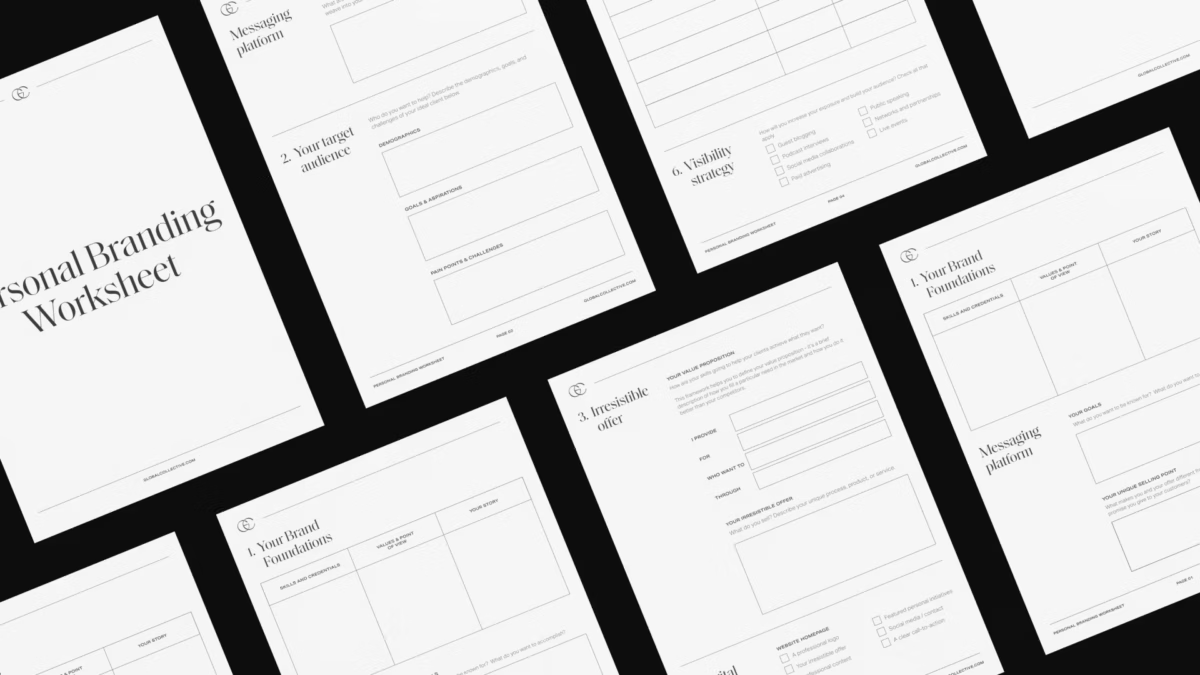
Our free resources can help you define your personal brand, level up your marketing plan, and reach your target audience.
Analyze your current clients to reveal ideal-fit patterns
The fastest way to define your real estate target market is to study the clients you have already served. Who are they? What do they have in common? Your past transactions hold patterns that are more reliable than guesswork.
Start by reviewing your client history across four dimensions:
- Demographics: Are your clients primarily young professionals, retirees, or families? Do they share similar income levels or household structures?
- Geographics: Are they relocating from out of state, or are they deeply rooted in your local market?
- Psychographics: What do they value? Are they motivated by investment returns, family needs, or lifestyle goals?
- Transaction behavior: Are they first-time homebuyers, repeat buyers, or sellers looking to trade up or downsize?
Use your customer relationship management (CRM) system or a simple spreadsheet to group clients by type, transaction value, and referral source. Look for clusters that match your strengths. These patterns are almost always more revealing than gut instinct.
That quote gets at the real cost of vague targeting. If you notice you are attracting a lot of first-time buyers or working frequently with luxury sellers, ask yourself why. What is it about your approach, your expertise, or your brand that draws these groups to you? Do your strengths naturally align with their needs? And most importantly, is this the audience you want to keep serving?
As Veda Bawo, director of data governance at Raymond James, put it: “You can have all of the fancy tools, but if [your] data quality is not good, you’re nowhere” (MIT Sloan Management Review). The same principle applies to your real estate contact database. If your CRM data is incomplete or disorganized, the patterns you need will stay hidden.
This kind of honest review helps you move from reactive marketing to deliberate positioning. When you align your skills with the audiences you serve best, or the ones you want to serve, you build a targeting approach that grows your business with purpose instead of noise.
Finding market gaps and opportunities in 2026
Beyond your existing clients, look at the broader market. Every real estate market has gaps: underserved client segments or shifting demand patterns that create openings for agents willing to specialize.
Remote and hybrid work migration
As of 2026, remote and hybrid workers continue to prioritize home office space and proximity to lifestyle amenities over commute distance. This has created consistent demand in suburban and secondary markets that many agents still have not claimed. If your market is seeing an influx of out-of-state buyers who work from home, that is a segment worth studying.
Downsizing demand
In the past 12 months, downsizing demand among empty nesters has remained a significant market segment, particularly in areas with high inventory of large single-family homes. These sellers often need guidance on right-sizing into condos, townhomes, or age-restricted communities. If you already work with older homeowners, this could be a natural extension of your niche.
Multigenerational households
Multigenerational living arrangements have grown steadily in the U.S. over the past decade, and in 2026 they remain one of the most active demand drivers reshaping local real estate markets. Buyers searching for homes with in-law suites, dual primary bedrooms, or separate entrances represent a specific and often underserved audience.
Spotting these gaps is only half the work. The real question is whether any of these segments align with your existing client type, your communication style, or your local market knowledge. Filling a market gap becomes far more effective when you connect it to what you already do well.
When the Guthrie Schofield Group launched their digital presence in early 2024, they faced the same challenge many agents face in 2026: building visibility in a defined market from scratch. By focusing on a specific geographic niche in the Cape Cod market and pairing it with a disciplined content approach, they generated over 273,000 search impressions in six months, saw a 36% increase in engaged leads, and brought their lead acquisition cost down to $21 per buyer. One blog post alone led to a multimillion-dollar sale (Source: Luxury Presence Case Study: Guthrie Schofield Group, 2024).
That result did not come from broad marketing. It came from knowing exactly who they wanted to reach and building every piece of content around that audience.
Map your message to your audience’s mindset
Once you have identified your ideal audience, the next step is to speak their language. Different buyer and seller personas have distinct goals, emotions, and decision-making styles. Matching your messaging to those mindsets is what separates agents who attract the right clients from agents who just attract attention.
Here is a framework for tailoring your messaging across three common real estate personas.
First-time buyers
This segment is often excited but overwhelmed. They are looking for clarity and confidence. Speak in reassuring, educational, and clear tones.
- Break down the buying process into manageable steps.
- Answer common questions before they are asked.
- Use friendly, jargon-free language and position yourself as a guide, not a salesperson.
Illustrative example: “Buying your first home does not have to be stressful. Here is what to expect, and how I will make sure you feel confident every step of the way.”
Luxury sellers
High-net-worth individuals value expertise and discretion. Their free time is limited, so your content should focus on data and results rather than lengthy explanations.
- Lead with experience, track record, and market knowledge.
- Use polished branding and high-quality visuals.
- Share specific success metrics that highlight your value in their price range.
Illustrative example: “With over $20M sold in your neighborhood, I understand what the luxury buyer in 2026 wants and how to position your home to meet the moment.”
Investors
Focused on return on investment, these buyers and sellers are analytical and driven by efficiency. A style that is concise and opportunity-focused will be most effective.
- Lead with numbers, market trends, and upside potential.
- Show you understand capitalization rate (cap rate), which is the annual net operating income divided by the purchase price, as well as rent projections and resale timelines.
- Skip the filler and get to the point quickly.
Illustrative example: “This duplex offers a projected 6.8% cap rate with value-add potential, located just minutes from the city’s newest tech hub.”
The table below summarizes how to adjust your tone, content focus, and proof points for each persona:
| Persona | Tone | Content focus | Proof points |
| First-time buyers | Reassuring, educational | Step-by-step guides, FAQ content, jargon-free explanations | Client testimonials, number of first-time buyers helped |
| Luxury sellers | Polished, data-driven | Market reports, pricing strategy, high-end visuals | Sales volume, average days on market, neighborhood expertise |
| Investors | Concise, analytical | Cap rates, rent projections, market trend data | Portfolio performance, deal volume, ROI examples |
Try writing out your own version of this for your specific real estate target market. Then conduct a real estate brand audit of your real estate website, your social media profiles, and your real estate email campaigns. Make sure every channel is speaking the same language to the same person.
Choosing the right marketing channels for your real estate target market
Not all marketing platforms work for every audience. A retiree looking to downsize may respond better to direct mail or a Facebook community group, while a millennial buyer in 2026 is more likely to engage with Instagram Reels or TikTok walkthroughs. Knowing where your audience spends their time determines whether your message actually gets seen.
- Social media marketing: Instagram and TikTok tend to reach younger buyers under 40. Facebook and LinkedIn are stronger for professionals and older demographics. Choose based on your persona, not your personal preference.
- Search engine optimization (SEO) and real estate content writing: Blog posts, neighborhood guides, and market updates attract buyers and sellers through organic search. This channel compounds over time and is especially effective for agents building a hyperlocal niche.
- Email marketing and lead nurture: Segmented real estate newsletters and drip sequences keep you top of mind with leads who are not ready to transact yet. This is where a CRM built for real estate, like Luxury Presence’s CRM, helps you maintain a personal touch at scale by tracking each client’s journey from first contact to closing.
- Paid advertising: Google Ads for real estate, Facebook ads, and Instagram ads let you put your message in front of a defined audience segment. Paid channels are most effective when you already know exactly who you are targeting.
The right channel mix depends entirely on your audience. An agent targeting investors will get more traction from data-heavy blog content and LinkedIn posts than from Instagram Stories. An agent targeting first-time buyers will likely see better results from short-form video and educational email sequences. Match the channel to the persona, not the other way around.
Refining your strategy over time
Your ideal audience is not fixed. It will shift as the market changes, and your approach should shift with it. The agents who stay aligned with their target clients are the ones who track what is working and adjust based on data, not assumptions.
Set up a simple tracking system that captures engagement and conversion data across your channels. Use a spreadsheet or dashboard where you log social media interactions, website traffic sources, and lead conversion rates. Google Analytics can show you which content drives the most engagement and where your visitors are coming from.
If you are using our CRM, tag leads based on their source and track which types of content or outreach produce the highest conversion rates. This gives you a clear picture of which audience segments are responding and which ones are not.
Review this data monthly. Look for patterns. If your Instagram content is generating views but no inquiries, the audience may not match your ideal client. If your neighborhood blog posts are driving qualified leads, double down. The goal is not to do more marketing. It is to do the right marketing for the right people.
Luxury Presence can elevate your marketing strategy
Learn how we can help take your real estate business to the next level. Schedule a time to speak with one of our branding experts today.

FAQs
About the author

Marketing Manager
Kate Evans is a content marketing strategist at Luxury Presence, the leading growth platform for high-performing real estate professionals. She develops data-driven editorial content and supports SEO strategy and brand voice frameworks that help agents attract qualified leads and establish market authority. Her published work covers topics including CRM strategy, social media marketing, and digital growth, supporting thousands of agents in scaling their businesses through modern marketing.