
Gross commission income (GCI) in real estate is the total revenue an agent earns from transaction commissions before any expenses are deducted. It is the single most important number for understanding your top-line earning power, and in 2026, knowing how to track it, calculate it, and grow it separates agents who build predictable businesses from those who guess their way through the year.
Whether you are a newer agent trying to hit your first $100,000 or a veteran aiming to break past $300,000, GCI gives you the scoreboard you need to make smarter decisions about where to invest your time, money, and energy.
This guide breaks down exactly what GCI means, how it differs from net commission income (NCI), how to calculate it with real examples, and six strategies you can put to work right now to grow your gross commission income in 2026 and beyond.
Find It Fast
Key takeaways
- GCI is your total commission revenue before expenses. NCI is what you actually keep after brokerage splits, fees, marketing costs, and taxes.
- The formula is simple: GCI equals your total sales volume multiplied by your commission rate, divided by 100.
- According to NAR data, the median GCI for agents with 16 or more years of experience is roughly $85,000 per year, while agents closing 25 or more deals annually are far more likely to exceed $300,000.
- The NAR settlement finalized in August 2024 changed how buyer’s agent compensation is negotiated, making it more important than ever to articulate your value and track your numbers.
- Agents who pair consistent marketing investment with a CRM report significantly higher GCI than those who do not.
- Six strategies to grow GCI: set a clear income goal, build a referral program, prioritize lead generation, invest in marketing, pick a niche, and put the right technology to work.
What is GCI in real estate?
Gross commission income is the total dollar amount an agent earns from commissions on real estate transactions during a given period. GCI does not subtract business expenses such as marketing costs, brokerage fees, taxes, or any other direct or indirect costs. Think of it as your gross revenue line: the number at the very top of your personal income statement before anything comes out. Because GCI captures your full earning power from closed deals, it is the metric most brokerages use to rank agent production, determine cap thresholds, and evaluate team performance. It is also the starting point for every financial plan you build for your business.
Gross commission income vs. net commission income
Net commission income (NCI) is your take-home pay. It is your GCI minus every expense required to earn that commission, including:
- Transaction fees
- Referral fees
- Marketing and ad spend
- Team and brokerage splits
- Taxes
You should include any cost directly tied to earning your commission in this figure, such as fees paid to a photographer, videographer, contractor, or interior designer. Taxes should always be the last expense you calculate because you are only taxed on your net income.
| GCI | NCI | |
| Represents | Total commission revenue earned | Profit after all deductions |
| Deductions | None | Splits, fees, marketing costs, and taxes |
| Purpose | Measure overall sales performance | Assess actual profitability |
NCI calculation example
Suppose you close a deal that earns you $12,500 in GCI. Here is how your NCI might break down:
- GCI: $12,500
- Brokerage split (30%): -$3,750
- Transaction fee: -$395
- Photography and staging: -$800
- Marketing costs allocated to this deal: -$500
- Estimated self-employment and income tax (25% of remaining): -$1,764
- NCI: $5,291
That is a 42% take-home rate on a $12,500 commission. Understanding the gap between GCI and NCI is what separates agents who feel busy from agents who are actually profitable. When you see the math clearly, you can make better decisions about negotiating splits, controlling expenses, and choosing which deals are worth your time.
Why real estate GCI is important in 2026
GCI is more than a number on a spreadsheet. It is the metric that tells you whether your business is growing, stalling, or shrinking. When you track your GCI consistently, you can:
- Measure your production against your own historical performance
- Spot seasonal or location-based trends in your closings
- Evaluate whether your commission rates are competitive
- Set income goals grounded in real math, not hope
- Plan your expenses against a known revenue baseline
- Track the return on your lead generation campaigns
- Benchmark yourself against competing agents in your market
- Identify where you can gain market share and income
- Monitor progress toward your brokerage-negotiated cap
In 2026, with commission structures shifting and buyer representation agreements now standard, tracking GCI gives you the clarity to adapt your business model rather than react to it.
How to calculate GCI
The simplest way to calculate your annual GCI is to add together every commission you have earned that year. For higher transaction volumes, a formula reduces errors and saves time:
- GCI = Total Sales Volume x (Commission Rate / 100)
A few variables can add complexity to this calculation:
- If your commission rate changes depending on the transaction type (commercial vs. residential, rental vs. purchase), calculate the GCI for each commission separately and then add the results together.
- Any seller concessions that change your commission will also require a separate GCI calculation for that deal.
Real-life GCI examples
These examples show how sale price, commission rate, and split structure affect GCI.
Example 1: Standard residential sale
- Scenario: An agent represents the seller on a $500,000 home sale. The agreed-upon commission rate is 5% of the sale price, split equally between the listing agent and the buyer’s agent.
- Calculation:
- Total commission: $500,000 x 5% = $25,000
- Listing agent’s share: $25,000 / 2 = $12,500
- GCI: $12,500
Example 2: Higher-price sale with a 60/40 split
- Scenario: An agent represents the buyer in a $2.5 million property purchase. The commission rate is 5%, with 60% going to the listing agent and 40% to the buyer’s agent.
- Calculation:
- Total commission: $2,500,000 x 5% = $125,000
- Buyer’s agent share: $125,000 x 40% = $50,000
- GCI: $50,000
Example 3: Dual agency
- Scenario: An agent acts as both the listing agent and the buyer’s agent on a property sold for $750,000, earning the full 4% commission.
- Calculation:
- Total commission: $750,000 x 4% = $30,000
- GCI: $30,000
Limitations of GCI calculations
GCI is a useful shorthand, but it can mislead you if you treat it as the whole picture. Here are the specific situations where GCI alone falls short:
- High brokerage splits: An agent earning $200,000 in GCI on a 50/50 split keeps far less than an agent earning $150,000 on a 70/30 split. GCI does not reflect that difference.
- Heavy lead costs: If you spend $30,000 a year on paid advertising to generate your pipeline, your GCI looks the same as an agent who spends $3,000 on referrals. Your profitability does not.
- Referral fees: A 25% referral fee on a $20,000 commission cuts $5,000 from your actual earnings. GCI does not capture that.
- Team structures: Team leaders distributing leads to agents absorb costs that solo agents do not. Comparing GCI across different business models without adjusting for structure is misleading.
- Market fluctuations: External forces like interest rate changes, inventory shifts, and seasonal cycles can cause GCI swings that have nothing to do with your effort or skill.
As the industry continues to adapt to the post-settlement landscape, agents are also adopting alternative compensation models such as flat fees or hourly rates. As these models grow, GCI will become one of several metrics for measuring success rather than the only one.
The NAR settlement and real estate GCI
The NAR settlement agreement finalized in August 2024 addressed longstanding practices around cooperative compensation (the commission offered by one side of the transaction to the other). It removed the requirement for listing agents to offer a set commission to buyer’s agents through the MLS, which has changed how commissions are negotiated across the industry. For agents tracking GCI in 2026, the settlement created three specific shifts:
- Downward pressure on the commission pool: Sellers may now choose to pay less or nothing to the buyer’s side. This shifts the cost to buyers and can reduce the total commission available on a given transaction, affecting buyer’s agents’ GCI in particular.
- Greater scrutiny of agent fees: Agents need to clearly articulate what they do and why their fee is worth it. In a market where fees face more negotiation, agents who cannot demonstrate measurable value risk smaller commissions or fewer clients.
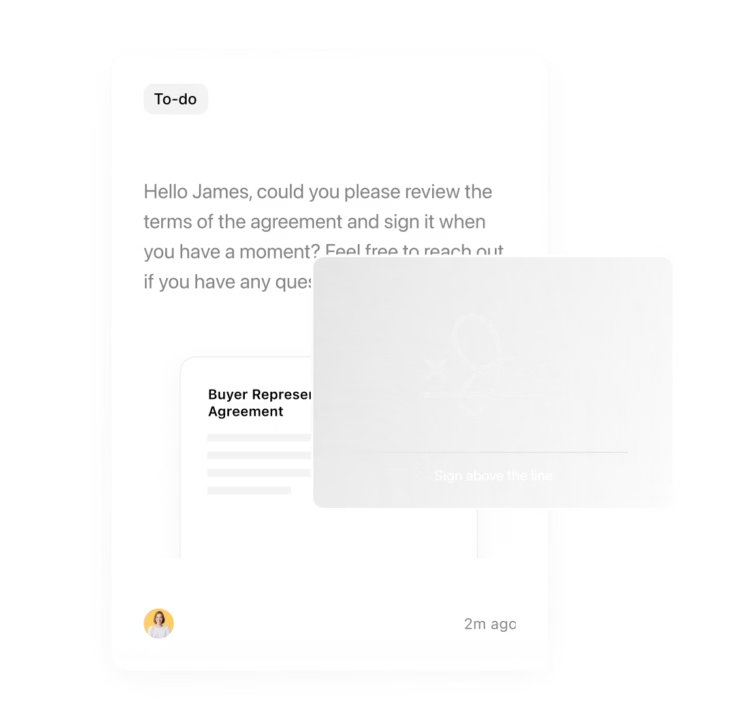
- Upfront fee negotiation for buyer’s agents: Buyer’s agents must now negotiate their compensation directly with clients before showing properties. This requires a clear value proposition and a signed buyer representation agreement.
Buyer’s agent comp strategies
Get three buy-side compensation structures that will appeal to clients while protecting your paycheck. We also include templates with sample language you can use to amend your current buyer’s agreement.
Opportunities in the post-settlement market
While these changes may reduce GCI for agents who do not adapt, they also create openings for those who do:
- Differentiation through service: Agents who focus on specialized services, measurable marketing results, and a strong client experience can justify their fees and win more business.
- New business models: Brokerages are developing fee-for-service and exclusive buyer representation models that attract clients who want transparency in how they pay for real estate services.
- Stronger client relationships: Agents who proactively explain their compensation, back it up with data, and focus on client-focused approaches are well-positioned to grow GCI even as the rules change.
General commission stats
GCI for real estate agents varies significantly based on niche, experience, and transaction volume. Here is where the numbers stand heading into 2026. For a state-by-state breakdown, see our guide to average real estate agent salaries.
Average income for real estate agents
- According to the NAR Member Profile, the median GCI for agents with 16 or more years of experience is approximately $85,000 per year. Newer agents tend to earn less, reflecting fewer transactions and a smaller sphere of influence.
Niche-specific GCI benchmarks
| Agent niche | Typical annual GCI range | Key driver |
| Residential (general) | Aligns with national median | Market dynamics and client base |
| Luxury residential | Often exceeds $300,000 | Higher sale prices and commission rates |
| Commercial | Can exceed residential averages | High transaction values, fewer total deals |
| High-volume (25+ deals/year) | More likely to exceed $300,000 | Transaction count and pipeline consistency |
| Low-volume (fewer than 10 deals/year) | Often under $100,000 | Limited pipeline and market reach |
These figures highlight how niche specialization, transaction volume, and market focus dramatically influence GCI. Agents at the higher end of these ranges almost always invest in marketing, technology, and a defined niche, which also affects their NCI.
How to boost your GCI in 2026
Here are six strategies that can help you grow your gross commission income this year. None of them require luck. All of them require consistency.
1. Set a goal for GCI growth
You cannot hit a target you have not defined. Start by determining your annual target income and the average annual expenses required to earn that income. Add those two figures together, and you have your GCI goal for the year. Once you have that number, break it down. Divide by four for quarterly targets. Divide by 12 for monthly targets. Then reverse-engineer the math: how many transactions do you need at your average commission to reach each target? To give your goal a reality check, analyze your GCI over the last two years. Look at the trend line. Use those numbers to set a goal that is ambitious but grounded in your actual production history, not wishful thinking.
2. Develop a real estate referral program
Strategic referral partnerships are one of the highest-margin ways to grow GCI. When you refer a client to another agent, you save the time and money of serving that client but still collect a referral fee when the deal closes. When you receive referrals, you get a warm lead with built-in trust. Build referral relationships with agents in other markets, lenders, financial advisors, attorneys, and past clients. The agents who treat referrals as a system rather than an accident consistently earn more.
3. Prioritize lead generation
Lead generation is the core variable in growing your GCI. There are dozens of ways to generate leads: outbound phone calls, building local connections, search engine optimization, predictive analytics, open houses, and community events. The key is not going all-in on any single channel. Use a mix of lead generation tactics designed to get qualified contacts into your database. Then measure which channels produce the most closed deals per dollar spent, and double down on those.
4. Invest in real estate marketing
More agents are recognizing that marketing and advertising directly affect GCI. In the Luxury Presence State of Real Estate Marketing Report, agents who spent more on marketing consistently reported higher gross commission income. Some agents surveyed reported that a $20,000 marketing investment helped them double their yearly income.
“Yes, it will cost you some money to maintain them as a developer but I know the return on this investment and the style in which I want my brand recognized will be worth every penny.”
— Jennifer Galjour, Luxury Presence Client
A strong real estate website is the foundation. It works around the clock to capture leads, showcase your listings, and establish your credibility. Layer on content marketing, social media marketing, and paid advertising campaigns, and you have a system that consistently puts your name in front of the right people. The math is straightforward. If you can trace $5,000 in ad spend to $50,000 in GCI, that is a 10X return. Track every dollar in and every dollar out so you know exactly which marketing channels are earning their keep.
Expert website design services
Every day, Luxury Presence creates and manages real estate websites for some of the biggest agents, teams, and brokerages in the country. Learn how we can transform your online presence.

5. Find a real estate niche
Do not underestimate the power of specialization. Focusing on a dedicated real estate niche can establish your credibility and allow you to charge a premium within a specific location, property type, or audience. For example, you could specialize in new-construction condo sales, waterfront properties, or farm and ranch transactions. As you build your reputation in a given niche, more potential clients will seek you out over agents who try to serve every segment. That demand gives you pricing power, which directly increases your GCI per transaction.
6. Put the right technology to work
Technology is not a nice-to-have in 2026. It is a GCI multiplier. A CRM built for real estate lets you track leads, automate follow-ups, and maintain personal touchpoints at scale, increasing the likelihood that leads convert to closed deals.
“Our data shows agents who use a CRM have a GCI that’s 40% higher than those who do not, so if you’re not already tracking and organizing your contacts somewhere, take this as a sign to get started.”
— Malte Kramer, CEO, Luxury Presence
Beyond your CRM, tools like targeted paid advertising, virtual tours, and 3D property visualizations help you reach high-value prospects and handle more transactions without burning out. Luxury Presence’s SEO & GEO, Social Media Management, and Paid Ad Management, for example, keep your brand visible and your pipeline full by delivering professional-grade marketing at speed, with nothing published until you approve it. That kind of always-on system saves agents 10 or more hours per week on marketing tasks while maintaining consistent lead flow.
About the author

Marketing Manager
Kate Evans is a content marketing strategist at Luxury Presence, the leading growth platform for high-performing real estate professionals. She develops data-driven editorial content and supports SEO strategy and brand voice frameworks that help agents attract qualified leads and establish market authority. Her published work covers topics including CRM strategy, social media marketing, and digital growth, supporting thousands of agents in scaling their businesses through modern marketing.