
In 2026, the gap between agents who run their business on a modern real estate website platform and those still relying on a one-time custom build has never been wider. A SaaS (software-as-a-service) website builder gives real estate agents a continuously updated, fully managed web presence that includes IDX (Internet Data Exchange) search, lead capture, SEO, and marketing tools in a single subscription. A traditional website provider, by contrast, delivers a static site that requires separate developers, manual updates, and unpredictable costs every time something needs to change. This article breaks down the differences so you can make a clear, informed decision about your real estate website design and long-term digital strategy.
Find It Fast
Key takeaways
- A SaaS real estate website builder handles hosting, security, updates, and new feature releases as part of your subscription, so you never pay a separate developer to keep your site current.
- Traditional website providers typically require $5,000 to $25,000+ upfront for a custom build, plus ongoing maintenance fees billed per update. SaaS platforms charge a predictable monthly or annual fee with no surprise invoices.
- Luxury Presence, a SaaS website builder for real estate agents, powers sites for 30% of the WSJ RealTrends Top 100 agents and delivers more than 60 million annual visitors across its client websites.
- SaaS platforms ship continuous improvements, including SEO updates, AI-powered content tools, and new IDX features, to every client simultaneously without additional charges.
- Choosing a SaaS model means you own the growth trajectory of your site. You can add tools, scale traffic, and integrate CRM (Customer Relationship Management) workflows without rebuilding from scratch.
What is SaaS in the context of real estate websites?
SaaS stands for software-as-a-service. It is a cloud-based model where software applications are hosted and maintained by a provider and accessed through the internet. You do not install anything locally or manage your own server.
For real estate agents, a SaaS website builder means your website is managed and continuously updated by the platform provider. You do not maintain the software yourself. Luxury Presence, for example, handles hosting, security patches, IDX data feeds, and feature releases on your behalf.
SaaS companies operate on a subscription model. You pay a predictable monthly or annual fee that covers access to the latest technology, ongoing support, and all maintenance. Compare that to a traditional provider such as a custom website design firm, a lead-generation-focused website platform, or an AI-powered real estate CRM and website provider, where the initial build is typically a one-time project and every subsequent change comes with a separate invoice.
Agent Image vs. Luxury Presence
Get the details you need, including plan breakdowns and tool comparisons, to make a smart investment in your real estate business.
The benefits of a SaaS real estate website builder in 2026
A SaaS website builder gives real estate agents the flexibility and resources needed to grow in a market that changes fast. Traditional platforms tend to deliver static, one-time website builds. SaaS platforms deliver ongoing feature releases, built-in integrations, and continuous improvements that let your business scale without starting over. Below is a direct comparison, followed by a closer look at each advantage.
SaaS vs. traditional providers: a side-by-side comparison
| Feature | SaaS website builder | Traditional website provider |
| Upfront cost | Low to none. Billing begins at launch. | High. Custom builds often require $5,000 to $25,000+ upfront. |
| Maintenance responsibility | Handled by the platform | Requires developer intervention or manual updates |
| Update frequency | Continuous. All clients receive updates automatically. | On-demand. Billed separately per update. |
| Security | Automated patches and backups managed by provider | Manual updates required. Vulnerabilities may go unaddressed. |
| Scalability | Add tools and traffic capacity without redesign | Redesign or redevelopment typically required |
| IDX/MLS integration | Built-in and maintained by the platform | Third-party plugins with common compatibility issues |
| Pricing predictability | Fixed subscription with no surprise invoices | Variable. Ongoing development costs are unpredictable. |
Scalability that matches your growth
Whether you are an individual agent or leading a large brokerage, a SaaS real estate website platform can grow with your business. As your client base grows, you can add more tools and handle higher traffic volumes. No costly redesigns are required. Traditional website providers often need extensive developer intervention to handle increased demand or integrate new functionality.
Luxury Presence powers websites for 30% of the WSJ RealTrends Top 100 agents, a client base that spans solo practitioners and large brokerages. Across those sites, the platform handles more than 60 million visitors per year, a volume that would require significant infrastructure investment and developer overhead on a self-hosted or custom-built site.
By choosing a SaaS platform, you get a system that adapts to your real estate goals, market shifts, and changing client expectations. Your website stays current and aligned with how buyers and sellers actually search in 2026.
Built-in updates and maintenance
Traditional website builders typically require you to manage updates manually or hire developers to keep your site current. A SaaS real estate agent website builder provides continuous software updates, new features, and maintenance as part of your subscription.
Luxury Presence releases regular updates to keep your website secure and aligned with the latest industry standards, and that service is built into the cost. For example, when Luxury Presence updated its entire IDX property search to support a new hyper-specific home search filter tool, all clients received the update without additional charges. Across the platform, more than 140,000 SEO improvements have been deployed to client sites without manual intervention from clients.
This eliminates the need for downtime or complex upgrades. Your site remains functional and visually sharp, and you get more time to focus on closing deals and building relationships.
Security built into the platform
Real estate transactions involve sensitive client information, from financial documents to personal identification. SaaS platforms address this by including regular patches, automated backups, and compliance with modern security protocols as part of the subscription.
Traditional websites may leave vulnerabilities unaddressed unless they are manually updated. That gap between patches is where risk lives. SaaS platforms built for real estate should meet modern data protection standards. When evaluating providers, look for platforms that operate under frameworks such as SOC 2 Type II (AICPA), comply with GDPR (gdpr.eu) for any international client data, and adhere to CCPA (California Attorney General) requirements for California-based clients.
Integrated marketing and lead generation tools
A SaaS website builder does not just provide a website. It delivers a full platform for SEO and AI search visibility, done-for-you social media, paid advertising, and automated lead follow-up. Luxury Presence client websites collectively receive more than 60 million visitors per year, and the platform includes tools designed to convert that traffic into pipeline.
Here is what a SaaS real estate website platform typically includes that a traditional build does not:
- SEO and AI search visibility built into the platform, so your listings and content rank without a separate tool
- Customizable lead capture forms that convert site visitors into pipeline
- CRM integrations that connect your leads directly to your follow-up workflow, including Luxury Presence’s CRM, which is purpose-built for real estate agents to nurture leads and maintain client relationships with agent-approved, automated touchpoints
- Paid advertising and done-for-you social media managed from a single platform
That kind of backend simplicity matters because it removes friction between capturing a lead and acting on it. When your website, CRM, and marketing tools all live on the same platform, you spend less time switching between systems and more time in conversations that close deals.
Cost-effective and predictable pricing
Many traditional real estate website providers require large upfront investments and unpredictable ongoing development costs for updates and feature additions. SaaS platforms operate on a subscription model. You get clear monthly or annual fees that cover hosting, maintenance, and updates, with no surprise developer invoices.
The cost difference is not just theoretical. Agents who have switched from traditional providers to SaaS consistently report wasted time and money on their prior setups.
Luxury Presence offers pricing tiers that accommodate a range of agents with varying service and customization needs. Billing does not begin until your site goes live, and post-launch modifications are included rather than billed separately. That pricing structure gives agents better financial visibility while keeping the website current and secure.

How SaaS keeps your real estate business competitive in 2026
In 2026, the most competitive agents are using SaaS platforms that ship AI-powered features, automated lead follow-up, and SEO improvements on a continuous basis. Unlike traditional web providers that deliver a finished product and move on, a SaaS company keeps building. Every client benefits from every new release.
AI readiness and continuous feature delivery
The speed of AI adoption in real estate has made platform choice more consequential than ever. A traditional custom-built site cannot receive AI-powered features unless a developer builds and integrates them from scratch, at your expense and on your timeline.
A SaaS platform like Luxury Presence ships those capabilities to every client as part of the subscription. Luxury Presence’s SEO & GEO, Social Media Management, and Paid Ad Management deliver SEO-optimized blog content, social media posts, and paid advertising management, while AI Lead Nurture provides automated lead follow-up at a pace that would be impossible to replicate manually. Luxury Presence has published more than 74,000 blog posts across client sites at a 97.9% acceptance rate, a scale no traditional provider can match. Nothing publishes without agent approval, so you maintain full control over your brand voice while the system works in the background.
Integration flexibility
As your tech stack grows, your website needs to connect with new tools: transaction management platforms, e-signature services, advertising dashboards, and more. SaaS platforms are built to integrate. Traditional sites often require custom API work billed by the hour. On a SaaS platform, those integrations are maintained by the provider and available to every client.
Working with SaaS website builder Luxury Presence
Luxury Presence goes beyond offering a website. The platform gives real estate agents a system that grows alongside their business, from generating leads and nurturing prospects to closing deals and building long-term client relationships.
Here is what separates Luxury Presence from other real estate website providers in 2026:
- Real estate website design built on a SaaS platform, so your site receives every new feature and security update automatically
- Luxury Presence’s SEO & GEO, Social Media Management, and Paid Ad Management that together maintain your brand presence around the clock, generating qualified leads and saving agents 10+ hours per week on marketing tasks
- CRM for relationship management purpose-built for real estate workflows, with agent-approved automated touchpoints that track the entire client journey from first contact to closing
- 30% of the WSJ RealTrends Top 100 agents trust Luxury Presence with their digital presence
Disclosure: Luxury Presence is the publisher of this content and offers the platform discussed in this article.
Choosing the Right Real Estate Website Platform
The right real estate website platform should do more than look good at launch. As the comparison in this article shows, a SaaS model offers ongoing updates, built-in security, predictable pricing, and integrated marketing tools that help your site keep pace with the market. For agents who want a website that supports long-term growth without constant developer involvement, a managed SaaS platform is the stronger choice.
FAQs
Expert website design services
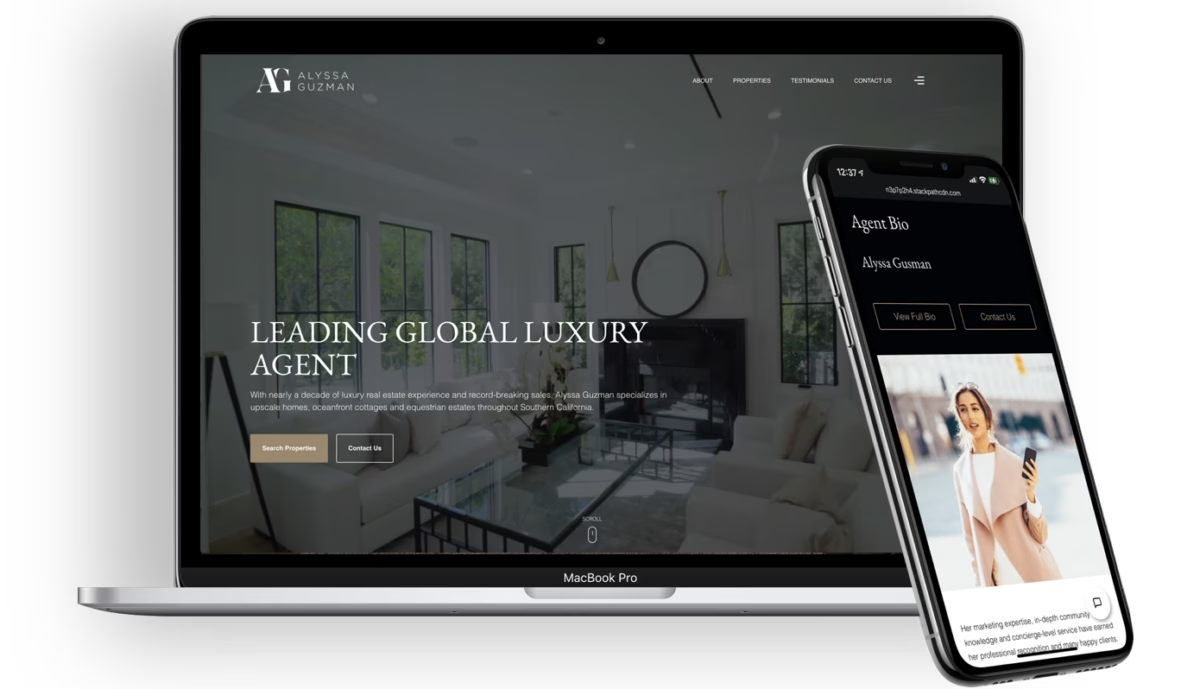
Every day, Luxury Presence creates and manages real estate websites for some of the biggest agents, teams, and brokerages in the country. Learn how we can transform your online presence.
About the author

Marketing Manager
Kate Evans is a content marketing strategist at Luxury Presence, the leading growth platform for high-performing real estate professionals. She develops data-driven editorial content and supports SEO strategy and brand voice frameworks that help agents attract qualified leads and establish market authority. Her published work covers topics including CRM strategy, social media marketing, and digital growth, supporting thousands of agents in scaling their businesses through modern marketing.