Whether you are a seasoned agent or new to the industry, a well-structured marketing plan supported by the right real estate marketing tools is the difference between consistent growth and stalled momentum in 2026. With the majority of buyers starting their home search online (NAR, 2024), agents who build a deliberate marketing toolkit around their website, content, advertising, and client relationships will win more listings, generate more inquiries, and close more deals. This guide breaks down every component of that toolkit, explains why each one matters, and gives you the specific tactics to put each piece to work.
Find It Fast
Key takeaways
- Your website is your marketing hub. Every channel you invest in, from paid ads to social media to email, should funnel traffic back to a site built for search visibility and lead capture.
- Consistent branding builds recognition. A unified look and voice across your website, social profiles, print materials, and email campaigns makes your business instantly recognizable in your market.
- Email still delivers the highest ROI. Segmented newsletters with market data and listing updates keep you in front of past clients and active prospects without competing for attention on social feeds.
- Video is no longer optional. Listing tours, neighborhood highlights, and short-form content on Instagram Reels and YouTube Shorts are how buyers evaluate agents and properties before making contact.
- A CRM keeps relationships from falling apart. Tracking every lead, automating follow-up sequences, and logging client interactions ensures no opportunity goes cold.
- SEO and paid ads work best together. Organic search builds long-term visibility while pay-per-click campaigns capture high-intent traffic right now. Running both creates a compounding effect over time.
Build a strong website
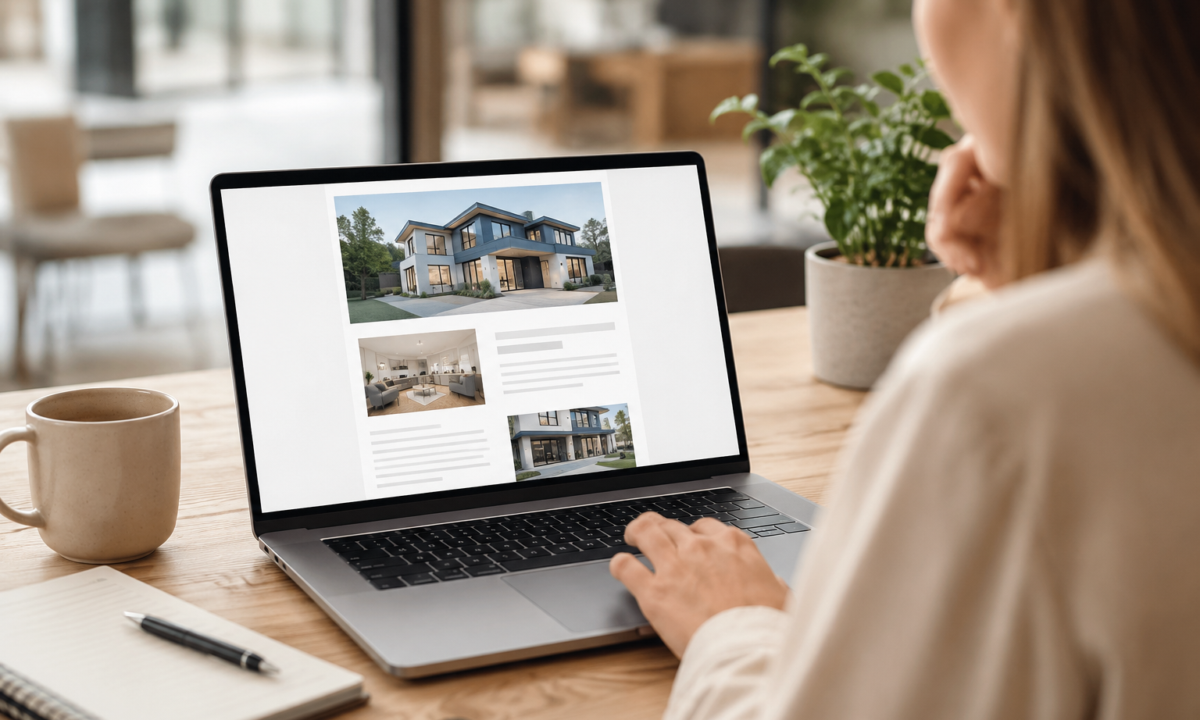
Your website is the hub of every marketing dollar you spend. Social posts, email campaigns, paid ads, and even print materials should all drive traffic back to a site designed to convert visitors into leads. In 2026, a real estate website that loads slowly, lacks mobile responsiveness, or buries its contact forms is costing you closings.
What a high-performing real estate website includes
- Clear navigation and calls to action: Structure your site with clear calls to action so visitors can find listings, request a consultation, or sign up for market reports within two clicks of landing on any page.
- IDX (internet data exchange) integration: Keep your listings updated with IDX tools that pull directly from your MLS, so buyers always see accurate data.
- Mobile responsiveness: More than half of real estate searches happen on a phone. If your site does not render correctly on mobile, those visitors leave.
- Lead capture forms: Place short forms (name and email at minimum) on listing pages, blog posts, and market report downloads to convert anonymous traffic into identifiable contacts.
- Client testimonials: Display reviews and success stories on your homepage and listing pages to build trust with first-time visitors.
- Analytics tools: Track web analytics to understand which pages generate the most leads, where visitors drop off, and which traffic sources deliver the highest-quality prospects.
The difference between a website that looks good and one that actually produces business comes down to measurable results. When agent Shannon Gillette launched a site built around SEO and lead capture, her team saw a 2.6x increase in website traffic, 1,093 website-generated leads, and a 91% lead reply rate within nine months. One of those leads resulted in a $4.3M closed transaction (Source: Luxury Presence Case Study: Shannon Gillette, 2025).
Insider tip
Run a technical SEO audit using Google Search Console at least once per quarter. Check for crawl errors, slow-loading pages, and missing meta descriptions. Shannon Gillette’s team reached 2,229 non-branded keywords in the top 10 within nine months by pairing a well-built site with consistent SEO attention.
Invest in branding materials
Your brand is what makes you recognizable before a prospect ever picks up the phone. Branding materials, including your logo, business cards, and a style guide, should communicate who you are and the specific value you bring to your market.
Branding materials every agent needs
- Logo: A high-quality, professionally designed logo that works at every size, from a website favicon to a yard sign.
- Brand book: A document that defines your color palette, fonts, brand voice, and style guidelines so every piece of marketing you produce looks and sounds like it came from the same business.
- Business cards: Printed cards that match your digital brand identity, including your website URL and a QR code linking to your listings or contact page.
Insider tip
Audit your brand consistency once per quarter. Open your website, your latest email newsletter, your Instagram profile, and your most recent print piece side by side. If the colors, fonts, or tone of voice do not match across all four, you have a branding gap that is diluting your recognition in the market.
Send newsletters that get opened
What belongs in a real estate newsletter
- Market data: Monthly or bi-weekly updates on median sale prices, days on market, and inventory levels for your farm area.
- New and coming-soon listings: Give subscribers early access to your listings before they hit the portals.
- Neighborhood content: Restaurant openings, school ratings, local events, and community news that positions you as the local authority.
- Clear calls to action: Every newsletter should include one direct link to schedule a consultation, view a listing, or download a resource.
Insider tip
Segment your email list into at least three groups: active buyers, active sellers, and past clients. Send different content to each audience. Active buyers get new listing alerts. Active sellers get market data and pricing trends. Past clients get quarterly check-ins and referral requests. Segmented sends consistently outperform single-list blasts on both open rate and click-through rate.
Publish blog posts that rank
A well-maintained blog does two things at once: it drives organic search traffic to your website, and it positions you as the go-to resource in your market. Every blog post you publish is a new page that Google can index, a new keyword you can rank for, and a new piece of content you can repurpose across email and social. The agents who publish consistently build a compounding traffic asset that grows month over month.
What to write about
- Neighborhood guides: “Best neighborhoods for families in [City]” or “A guide to [Neighborhood] real estate in 2026.”
- Buyer and seller education: “How to choose the right real estate agent” or “What to expect during a home inspection.”
- Market updates: Monthly or quarterly posts analyzing local pricing trends, inventory shifts, and interest rate impacts.
- Multimedia integration: Include images, embedded videos, and infographics to increase time on page and reduce bounce rates.
Cross-channel distribution: the repurposing framework
Every blog post, listing video, lead magnet, and newsletter you create should be distributed across at least three channels. Rather than creating new content for each platform, repurpose a single piece into multiple formats. Here is the three-step sequence that extracts the most reach from one piece of content:
- Newsletter excerpt: Pull the key stat or takeaway from your blog post and include it in your next email with a link to the full article.
- Social caption: Write a short-form caption for Instagram, Facebook, or LinkedIn that highlights the most compelling data point or tip from the post.
- Saved highlight or pinned post: Save the social post to an Instagram highlight or pin it on your Facebook page so it continues to work for you beyond the first 24 hours.
Insider tip
Batch your blog production. Write or outline four posts in a single session, then schedule them to publish weekly. Luxury Presence’s Content Marketing service has published over 74,000 blog posts at a 97.9% acceptance rate, proving that consistent volume paired with a quality standard is the formula that moves search rankings.
Market your listings like a brand
Every listing is a marketing opportunity, not just a line item on the MLS. The agents who treat each property as its own brand, with dedicated photography, video, landing pages, and ad campaigns, win more listings and sell them faster.
How to market a listing in 2026
- High-resolution photography: Hire a professional photographer for every listing. Properties with professional photos sell faster and for higher prices than those with amateur images.
- Listing videos: Create video tours and drone photography that give buyers a feel for the property’s layout, light, and surroundings before they schedule a showing.
- Dedicated single-property websites: Create a dedicated page for each listing with its own URL, full photo gallery, floor plan, neighborhood data, and a lead capture form.
- Social media promotion: Share listing content on Instagram Reels, Facebook, and LinkedIn with copy that highlights the property’s most compelling feature, not a generic description.
Insider tip
Create a dedicated single-property website for every listing priced above your market’s median. Run a $5 to $10 per day Facebook and Instagram ad campaign driving traffic to that page for the first seven days of the listing. This concentrated spend generates the most impressions during the window when buyer interest is highest.
Use video to build trust before the first meeting
Video is how buyers and sellers evaluate agents before they ever make contact. In 2026, short-form video on Instagram Reels and YouTube Shorts is the dominant format for real estate content, while longer-form property tours and neighborhood guides continue to perform on YouTube and agent websites. Video humanizes your brand and lets prospects feel like they already know you before the first conversation.
Types of video every agent should produce
- Brand video: A 60-to-90-second video that introduces you, your market, and the specific value you bring to clients.
- Property tours: Walkthrough videos for active listings, shot with stable footage and natural narration that highlights the home’s best features.
- Neighborhood highlights: Lifestyle-focused videos that show what it is like to live in the communities you serve, from local restaurants to parks to school drop-off routes.
- Market updates: Quick weekly or bi-weekly videos sharing one or two data points about your local market, filmed on your phone and posted to Reels and Shorts.
Insider tip
Batch-record three to five short-form videos (60 to 90 seconds each) in a single session: one property walkthrough, one neighborhood highlight, and one market update. Schedule them across Instagram Reels, YouTube Shorts, and your website’s blog in the same week to get maximum distribution from a single recording session.
Run your business on a CRM
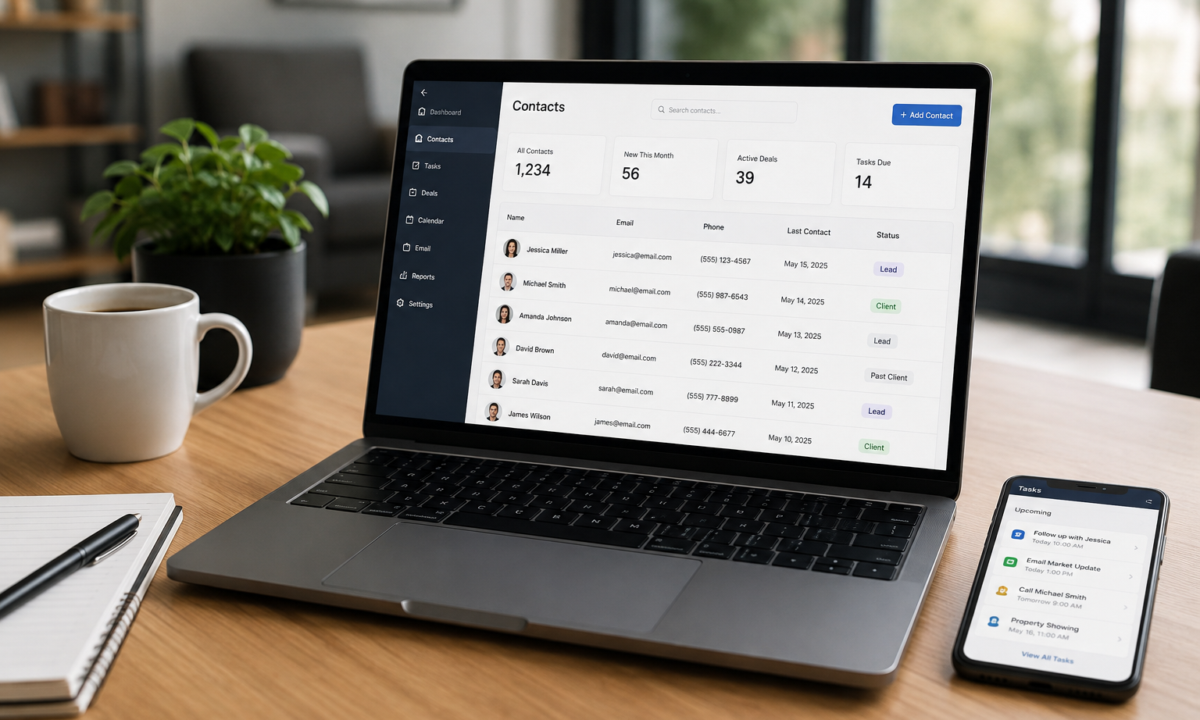
A customer relationship management (CRM) system is how you keep track of every lead, every client interaction, and every follow-up task across your entire pipeline. Without one, leads go cold, follow-ups get missed, and past clients forget you exist. In 2026, agents who run their business on a CRM built for real estate workflows close more deals because they never lose track of a relationship.
What to look for in a real estate CRM
- Lead segmentation: The ability to organize contacts by type (buyer, seller, past client, sphere of influence) so you can send the right message to the right person.
- Automated follow-up sequences: Set up personalized email and text sequences that deploy based on lead activity, such as a new inquiry, a saved search alert, or a listing view.
- Pipeline tracking: A clear view of where every contact sits in your pipeline, from first inquiry through closing, so nothing falls through the cracks.
- Integration with your marketing: Your CRM should connect to your website, email campaigns, and advertising so that leads captured from any channel flow into one system.
Luxury Presence’s CRM is purpose-built for real estate agents. It tracks the entire client journey from first contact to closing, automates relationship nurturing with personalized touchpoints, and integrates with your website and marketing campaigns so every lead lands in one place. Nothing sends without your approval, so every message maintains your personal voice.
Insider tip
Set up a saved search alert for every active buyer in your CRM. When a new listing matches a buyer’s criteria, use the alert as the trigger for a same-day personal outreach, not a generic automated email. A quick phone call or text referencing the specific property shows the buyer you are paying attention and keeps you ahead of agents who rely on automation alone.
Run PPC campaigns that convert in 2026
Pay-per-click (PPC) advertising puts your listings and services in front of buyers and sellers at the exact moment they are searching for real estate help. Unlike organic search, which builds over months, PPC delivers traffic immediately. In 2026, real estate remains one of the most competitive paid search categories, which means agents who use precise geo-targeting and high-intent keyword selection get far better results than those running broad campaigns.
According to Google Ads Help, geo-targeting allows you to restrict your ads to users within a specific radius of a location (Google Ads Help, 2026), making it particularly effective for open house promotion and hyperlocal listing campaigns.
Why PPC belongs in your real estate marketing tools
- Targeted visibility: Your ads appear only to people searching for real estate terms in your specific market, not to a general audience.
- Cost control: You only pay when someone clicks, and you set a daily budget cap so spend never exceeds what you have allocated.
- High-intent leads: PPC captures people who are already interested in buying or selling, which means the leads entering your pipeline are further along in their decision process than most organic visitors.
| PPC channel | Best use case | Recommended starting budget |
| Google Search Ads | Capturing buyers searching “homes for sale in [city]” | $500 to $1,000 per month |
| Google Performance Max | Cross-channel campaigns across Search, Display, YouTube, and Maps | $750 to $1,500 per month |
| Facebook and Instagram Ads | Listing promotion, open house traffic, and retargeting site visitors | $300 to $750 per month |
| YouTube Ads | Brand awareness and property tour promotion | $250 to $500 per month |
Insider tip
Set a minimum budget of $500 per month for local real estate keywords and use geo-targeting to restrict your ads to a 10-to-15-mile radius around your primary market. Add a negative keyword list excluding terms like “free,” “rental,” and “for rent” to prevent budget waste on non-buyer traffic.
Build your SEO foundation for 2026 and beyond
Search engine optimization (SEO) is how your website gets found by buyers and sellers who are actively searching for real estate services in your area. In 2026, Google’s guidance continues to prioritize pages that demonstrate experience, expertise, authoritativeness, and trustworthiness (Google Search Central, 2026), which means content quality and consistent publishing are the most durable SEO investments an agent can make. The higher you rank, the more organic traffic you receive, and the more credible your business appears to prospects who find you through search.
The SEO practices that matter most
- Local keyword targeting: Focus on terms your audience actually searches, such as “homes for sale in [city]” or “[neighborhood] real estate agent.” Use Google Search Console to identify which queries are already driving impressions to your site, then build content around those terms.
- Content frequency: Search engines reward websites that publish fresh, relevant content on a regular schedule. A weekly or bi-weekly blog post cadence is the minimum for agents who want to compete in organic search.
- Metadata: Every page on your site needs a properly written meta title and meta description. These are the lines that appear in search results, and they directly affect whether someone clicks through to your site.
- Local SEO: Claim and maintain your Google Business Profile with accurate contact information, business hours, and photos. Encourage satisfied clients to leave Google reviews, which directly influence your visibility in local map results.
- AI Overviews: Google’s AI Overviews feature, which generates summary answers at the top of search results, pulls from pages that provide clear, direct answers to common questions. Structuring your content with specific headings and concise answers increases the likelihood that your site is cited in these summaries.
Investing in SEO from the start pays compounding returns. Shannon Gillette’s site reached 2,229 non-branded keywords in the top 10 within nine months, a result that continues to generate organic traffic and leads without additional ad spend.
Insider tip
Audit your site’s Core Web Vitals score in Google Search Console every 90 days. Pages that fail the Largest Contentful Paint threshold (above 2.5 seconds) are penalized in mobile search rankings. Fix image compression issues first, as oversized images are the most common cause of slow load times on real estate sites.
Create lead magnets that grow your database
Lead magnets, or downloadable resources offered in exchange for contact information, are one of the most effective ways to grow your email list with prospects who have already shown interest in your market. By offering something genuinely useful, you turn anonymous website visitors into identifiable contacts you can nurture over time.
Lead magnets that work for real estate agents
- Market reports: Monthly or quarterly reports on local market trends, median prices, and inventory levels. These position you as the data source for your farm area.
- Buyer and seller guides: Detailed PDFs walking first-time buyers through the purchase process or helping sellers prepare their home for market.
- Checklists: Practical tools like a home inspection checklist, a moving timeline, or a seller’s pre-listing preparation list.
- Early listing access: Offer subscribers first-look access to coming-soon listings or off-market opportunities.
Insider tip
Gate your market report behind a simple two-field form (name and email only). Longer forms reduce conversion rates. Set up an automated three-email welcome sequence: email one delivers the report, email two shares a related blog post, and email three offers a no-obligation consultation call. This sequence moves a cold download into a warm conversation within seven days.
Build a marketing system that keeps working
The best real estate marketing tools do more than fill a checklist — they work together to create visibility, trust, and steady lead flow. When your website, SEO, content, email, advertising, and CRM all support one another, you build a marketing system that compounds over time instead of relying on one-off wins. Focus on consistency, track what performs, and keep refining the pieces that move your business forward.
FAQs
About the author

Marketing Manager
Kate Evans is a content marketing strategist at Luxury Presence, the leading growth platform for high-performing real estate professionals. She develops data-driven editorial content and supports SEO strategy and brand voice frameworks that help agents attract qualified leads and establish market authority. Her published work covers topics including CRM strategy, social media marketing, and digital growth, supporting thousands of agents in scaling their businesses through modern marketing.