
In 2026, the gap between agents who generate a steady pipeline of online leads and those who struggle to fill their calendar comes down to one thing: a system. Online lead generation in real estate is not about picking one tactic and hoping it works. It requires a layered approach that starts with a clear audience, runs through a conversion-ready website, and extends into paid ads, email, SEO, and social media, all working together. The median conversion rate for real estate websites sits at 2.8%, while top-performing sites reach 4.5% or higher (Greetnow, 2026). That spread tells you something important: the difference is not traffic volume. It is what happens after someone lands on your site. The nine steps below give you the full playbook to close that gap.
Key takeaways
- Define a specific target audience profile using the PFDD framework before building any campaign, because broad messaging dilutes every dollar you spend.
- A well-designed website with clear calls to action and low-friction lead capture forms is the foundation of owned lead generation.
- SEO-driven leads close at a 14.6% rate, making organic search one of the highest-ROI channels available to agents in 2026.
- Personalized email subject lines lift open rates by 26%, which means drip campaigns are worth the setup time.
- Paid ads on Google and Facebook deliver the strongest results when they drive traffic to dedicated landing pages, not your homepage.
- Reviews on Google Business Profile directly influence local search rankings and add measurable lift to conversion rates.
2026 real estate lead generation benchmarks
- Median website conversion rate: 2.8% (top quartile reaches 4.5%+)
- SEO lead close rate: 14.6%
- Personalized email open rate lift: 26%
- Google Ads mobile conversion rate: 2.47%
- Conversion lift from reviews and user-generated content: 3.8%
9 steps to improve your online lead generation in real estate
Your goal is to build a repeatable system where every channel feeds qualified prospects into your pipeline. Each step below covers a specific layer of that system, with benchmarks and execution details you can put to work this week.
Find It Fast
1. Define your target audience
Every lead generation campaign starts with a clear picture of who you are trying to reach. Without that clarity, your ad targeting is too broad, your content speaks to no one in particular, and your cost per lead climbs. The fix is the PFDD framework, which maps your ideal client’s pains, fears, dreams, and desires into a profile you can use across every marketing channel.
Here is what a completed PFDD profile looks like for a move-up buyer audience:
| PFDD element | Example for move-up buyers |
| Pain | “We’ve outgrown our starter home, but we can’t afford to make a mistake on the biggest purchase of our lives.” |
| Fear | “What if we overpay or buy in the wrong neighborhood and regret it?” |
| Dream | “A home that appreciates in value and fits our family for the next 10 years.” |
| Desire | “An agent who knows the local market better than anyone and will protect our investment.” |
Once you complete this exercise, every decision downstream becomes easier. Your blog topics, ad copy, email subject lines, and landing page headlines all speak directly to the profile you built here. Specificity is the multiplier. The more targeted your audience definition, the lower your cost per lead and the higher your conversion rate on every channel that follows.
2. Create a professional website

Your website is the hub of your entire lead generation system. Every ad click, social post, and Google search result eventually sends someone here. If the site loads slowly, looks outdated, or buries the call to action below the fold, you lose that visitor before they ever fill out a form. A lead-generating real estate website needs three things working together: a design that signals credibility within the first two seconds, a fast load time, and clear calls to action on every page.
The features that move the needle most for online lead generation include IDX property search with saved-search registration, neighborhood and community pages that rank in local search, and lead capture forms placed at natural decision points rather than hidden in the footer. When these elements work together, your site becomes the place where casual browsers turn into contacts in your database.
“They built a beautiful, modern site with smooth IDX integration, clear neighborhood pages, and lead forms that actually convert.”
— Jill Chen, Luxury Presence client
That combination of design, search functionality, and conversion architecture is what separates a website that generates leads from one that simply exists. If your current site lacks any of those three elements, that is the first bottleneck to fix before spending another dollar on ads or content.
3. Offer valuable content

Content is the engine that drives organic traffic to your website. Blog posts, video walkthroughs, and downloadable guides give search engines a reason to rank your pages and give prospects a reason to trust you before they ever pick up the phone. The key is to create content that maps directly to your PFDD profile from Step 1. If your target audience fears overpaying, publish a neighborhood price trend report. If they dream of finding the right school district, create a community guide that covers every school in your market.
Here are the content types that produce the strongest results for real estate agents:
- Blog posts answering common buyer and seller questions
- Community guides covering neighborhoods, schools, and local amenities
- Buyer guides that walk first-time purchasers through the process step by step
- Seller guides that explain pricing strategy, staging, and timeline
- Resource guides such as moving checklists and mortgage calculators
- Video content including listing tours, market updates, and client testimonials
Each piece of content should include a clear call to action, whether that is a property search registration, a downloadable PDF, or a consultation booking link. Content without a next step is a missed conversion opportunity. For a deeper breakdown, see the complete guide to real estate content marketing.
4. Use social media strategically in 2026
Social media marketing gives agents a way to stay visible between transactions and drive traffic back to their website. The platforms that matter most for real estate in 2026 are Instagram, Facebook, and LinkedIn, but each one serves a different purpose and audience.
Instagram is the strongest platform for visual storytelling. Property listings, virtual tours, client testimonials, before-and-after staging shots, and short-form video (Reels) all perform well here. Post three to five times per week and use location tags and neighborhood hashtags to reach local audiences. For more ideas, check out these 50 real estate Instagram post ideas, the guide to improving your real estate Instagram, and the best real estate Instagram accounts to follow for inspiration.
Facebook remains the most effective platform for paid lead generation in real estate. Organic reach has declined, but Facebook Lead Ads, which let prospects submit their contact information without leaving the platform, still convert at a steady rate for agents who target correctly. A strong starting campaign looks like this: target homeowners aged 35 to 65 within a 10-mile radius of your farm area, offer a free home valuation as the lead magnet, and set a daily budget of $20 to $30. Test two ad creatives against each other for two weeks, then pause the lower performer and scale the winner. Beyond paid ads, Facebook Groups remain useful for community engagement and referral visibility.
LinkedIn is the platform for agents who serve relocation buyers, corporate transferees, and high-net-worth investors. Agents who use LinkedIn should post market trend articles and neighborhood guides twice per week, engage in comments on posts from local business leaders, and link back to their website’s community pages. LinkedIn is not a volume play. It is a credibility play that pays off in higher-value transactions over time.
5. Implement email marketing
Real estate email marketing gives you a direct line to leads who have already raised their hand. Unlike social media, where an algorithm decides who sees your content, email lands in the inbox of every subscriber on your list. Personalized email subject lines increase open rates by 26% for real estate leads (WifiTalents, 2026), which means the effort you put into personalization pays off in measurable engagement.
The most effective structure for nurturing new leads is a drip campaign: a scheduled sequence of follow-up emails sent automatically over time. Here is a sample five-email drip cadence for a new buyer lead:
- Day 1: Welcome email with a link to your saved property search. Subject line example: “Your [Neighborhood] home search starts here”
- Day 3: Educational email covering the buying process timeline. Subject line example: “What to expect in your first 30 days as a buyer”
- Day 7: Market update with recent sales data for their target area. Subject line example: “[Neighborhood] just had 12 homes close this month”
- Day 14: Social proof email featuring a client testimonial and a link to your reviews. Subject line example: “How the Garcias found their home in 45 days”
- Day 30: Re-engagement email with a direct call-to-action to schedule a consultation. Subject line example: “Still searching? Let’s talk strategy.”
A customer relationship management (CRM) system built for real estate can sort leads into the right drip sequences and send messages at the right cadence based on each lead’s behavior. Luxury Presence’s CRM, for example, is designed to maintain a personal touch at scale by tracking the entire client journey from first contact to closing and automating follow-up touchpoints that agents review and approve before they go out. For more on building your email list and writing campaigns, see the real estate email marketing guide.
6. Improve lead capture forms on landing pages
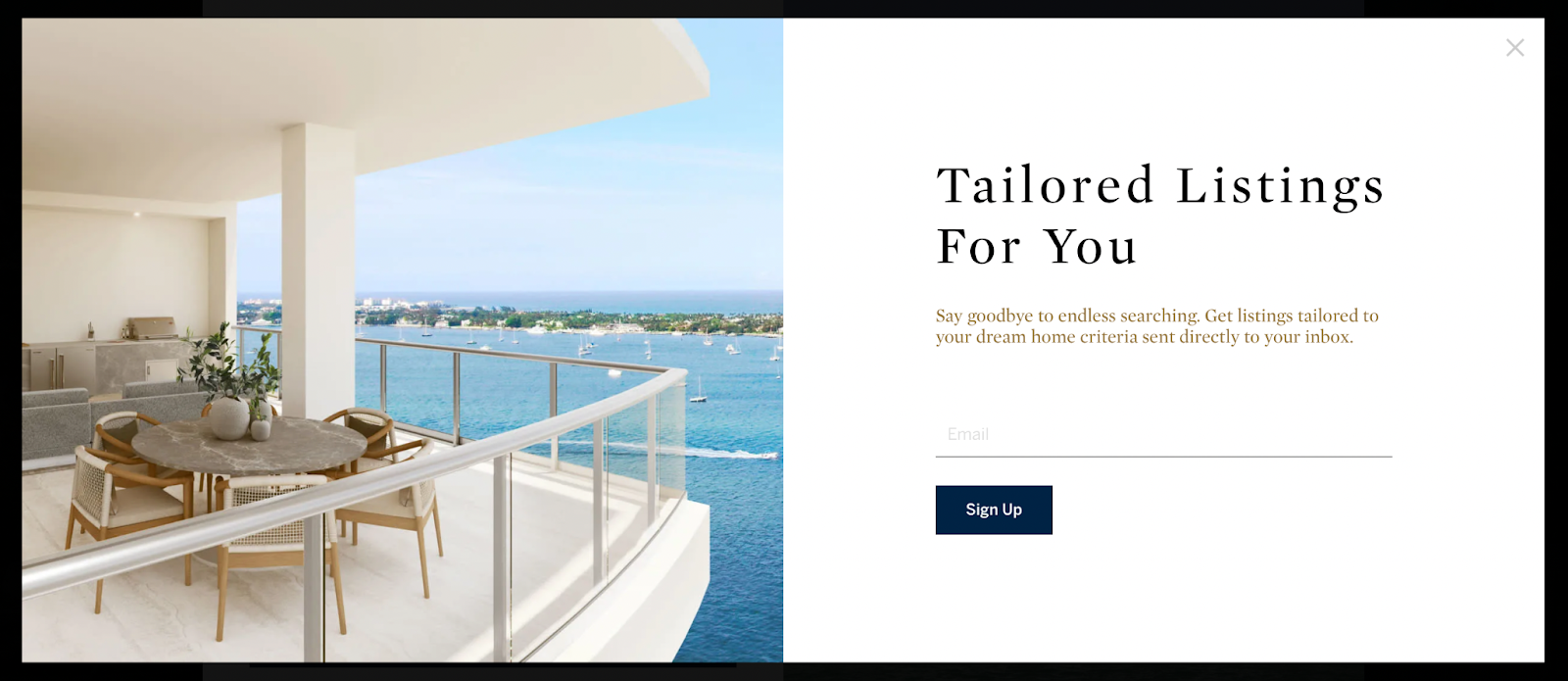
A landing page has one job: get the visitor to complete a single action. For buyers, that action is usually registering for a property search. For sellers, it is requesting a home valuation. The page should feature a clear headline that matches the ad or link that brought the visitor there, a short description of what they will receive, and a form that asks for only the information you need at this stage (name, email, phone).
Every extra form field you add creates friction. A three-field form will almost always outperform a seven-field form. If you need more information, collect it later in the relationship through your CRM follow-up sequence. The goal of the landing page is to get the lead into your system, not to qualify them on the spot.
High-converting landing pages share a few common traits: they load in under two seconds, they have no navigation menu (so the visitor cannot wander away), and they use a single, prominent call-to-action button with clear language like “See Homes Now” or “Get Your Home’s Value.” Test different headlines and button text every month to see what produces the highest conversion rate for your audience.
7. Invest in paid advertising
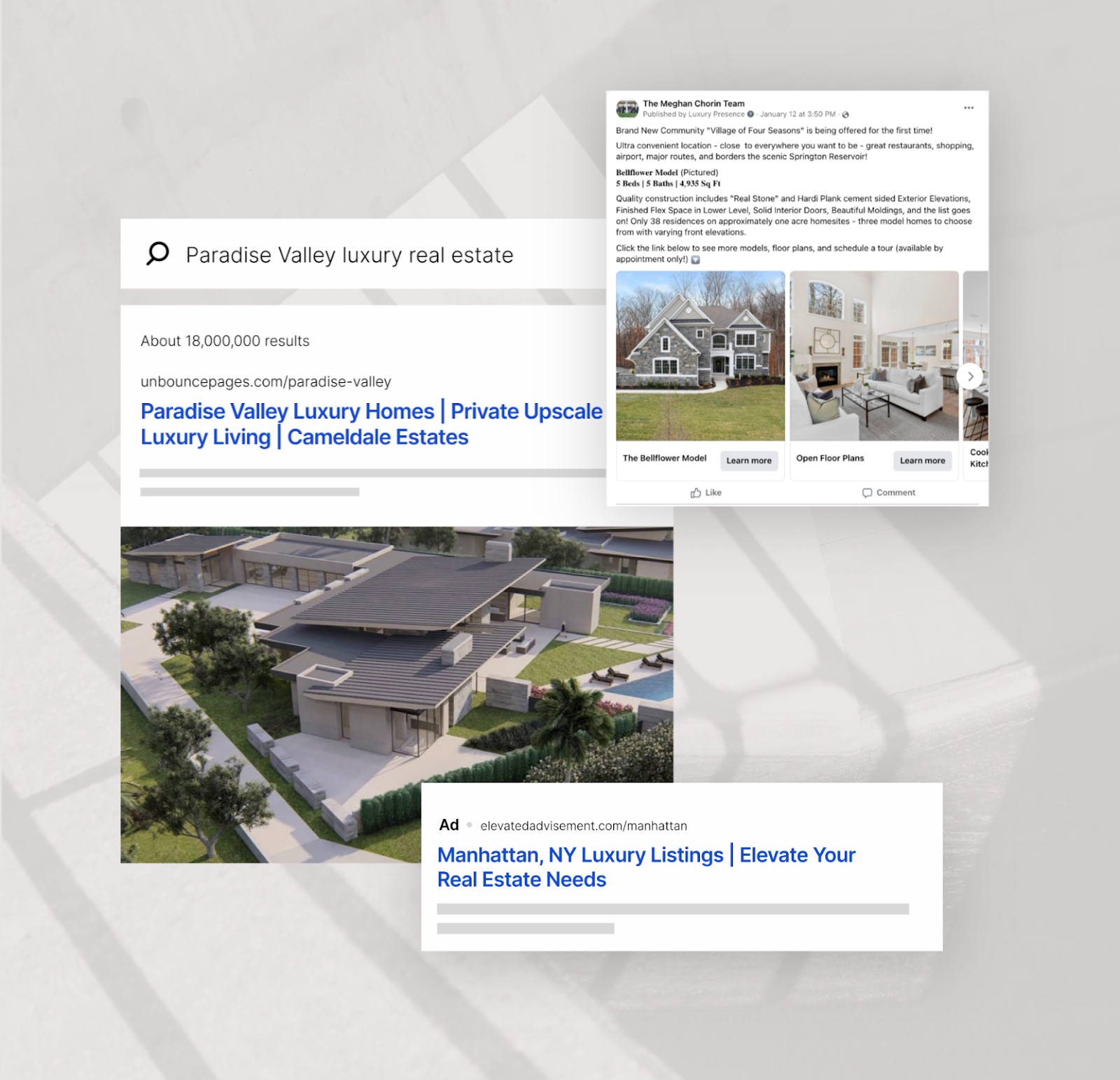
Paid advertising on Google and Facebook lets you put your message in front of people who are actively searching for homes or agents in your market. Google Ads leads for real estate average a 2.47% conversion rate on mobile (Promodo, 2026), which means for every 100 clicks, roughly two to three become a lead in your database. That math works when you pair ads with a dedicated landing page built to convert, not your homepage.
Google Ads also supports retargeting, the practice of showing ads to people who previously visited your website or interacted with your content. Retargeting keeps your name in front of warm prospects who browsed your listings but did not register. On Facebook, Lead Ads let prospects submit their contact information without leaving the platform, which reduces friction and increases form completion rates. Use a free resource, such as a neighborhood market report PDF or a home valuation, as the offer to prompt people to enter their email address.
“Because you’re sending people to your site instead of a third-party portal, you create the opportunity to turn any traffic into exclusive leads.”
— Tracy Tutor, real estate agent and author
That distinction between owned traffic and portal traffic is what makes paid ads worth the investment. When you drive clicks to your own website, you control the follow-up, the branding, and the data.
One real-world example: the Denise Ramey Team partnered with Luxury Presence to run Google Ads campaigns targeting 22 keywords across six locations. Over six months, the campaign generated 597 engaged leads, decreased cost per click by 27%, and increased ad impressions by 316% (Source: Luxury Presence Case Study: Denise Ramey Team, 2026).
Two things to monitor closely: first, track your return on ad spend weekly so you can pause underperforming campaigns and shift budget to what is working. Second, all real estate ads must comply with the Fair Housing Act. Review your targeting filters and ad copy for compliance before every campaign launch.
8. Don’t neglect SEO in 2026
Search engine optimization (SEO) is the channel that compounds over time. Unlike paid ads, where leads stop the moment you pause your budget, organic search traffic continues to arrive as long as your pages rank. In 2026, SEO-driven real estate leads close at a 14.6% rate (REDX, 2026), a close rate that outpaces most paid channels by a wide margin. That number alone makes SEO worth the effort.
Your website’s search rankings depend on a combination of technical factors (site speed, mobile responsiveness, clean code) and content factors (keywords, headings, internal links, and the depth of your pages). Because the details can be involved, many agents work with real estate SEO services to handle the technical side while they focus on creating content. The good news is that once your site is technically sound and your pages are well-structured, organic traffic builds on itself with relatively small ongoing adjustments to keep up with algorithm changes.
If you want to manage your own SEO, start with these three high-impact moves: use the right keywords in your page titles and headings, confirm that each page targets a specific search intent (informational, transactional, or navigational), and add internal links between related pages on your site. Here are additional resources to go deeper:
- The Ultimate SEO Checklist for Real Estate Agents
- Is Your SEO Provider the Right Fit for Your Business?
- Our Real Estate SEO Experts Reveal Google’s 100+ Ranking Factors
- How to Strengthen Your Real Estate SEO: 10 Strategies
9. Request reviews

Reviews are the most underused lead generation tool in real estate. User-generated content, including client reviews, boosts conversion rates by an additional 3.8% (). Beyond conversion, reviews directly influence your local search rankings. Google Business Profile and real estate-specific directories prioritize agents with a strong collection of recent, positive reviews.
The best time to ask for a review is one to two weeks after closing, when the client’s positive experience is still fresh. Send a short email with direct links to your Google Business Profile and Facebook page so they can leave a review with minimal effort. Also ask if they would be willing to provide a written testimonial you can feature on your website. The easier you make the process, the more reviews you will collect.
Display your strongest testimonials on your homepage, landing pages, and listing presentation materials. Reviews are not just a ranking signal. They are the social proof that turns a website visitor into a phone call.
10. Track which channels generate your leads
None of the nine steps above matter if you cannot measure which ones are producing results. Set up UTM parameters on every link you share in ads, emails, and social posts so you can see exactly which channel and campaign drove each lead to your site. Inside your CRM, tag every new contact with its source: Google Ads, Facebook, organic search, email, referral, or direct.
Review your channel performance monthly. Look at three numbers for each source: total leads generated, cost per lead, and conversion rate from lead to client. If Google Ads is producing leads at $40 each but only 1% convert to clients, while SEO leads cost you $0 in ad spend and close at 14.6%, that tells you where to invest more time and budget. Tracking is what turns a collection of tactics into a system you can improve quarter over quarter.
FAQ: Online lead generation in real estate in 2026
Develop your lead nurturing strategy
Turn leads into clients with our free scripts, follow-up schedules, and communication tips.

About the author

Marketing Manager
Kate Evans is a content marketing strategist at Luxury Presence, the leading growth platform for high-performing real estate professionals. She develops data-driven editorial content and supports SEO strategy and brand voice frameworks that help agents attract qualified leads and establish market authority. Her published work covers topics including CRM strategy, social media marketing, and digital growth, supporting thousands of agents in scaling their businesses through modern marketing.