According to Axios's review of National Association of Realtors data, the share of buyers who search for homes online has held at or near 100% since 2023. Your website is where most of those buyers form their first impression of you, often before they know your name.
That puts your website next to your database and your listings as one of the most important assets in your business. Built well, it works around the clock. It captures leads while you're at a showing, answers the questions prospects are too nervous to ask you directly, and makes your brand the obvious choice in a crowded market. Built poorly, it quietly costs you leads you'll never know you lost.
This guide walks through how to build a real estate website in 2026, covering strategy, platform selection, the pages that convert, SEO, and promotion.
1. Start With Strategy, Not Software
Before you touch a website builder, get clear on three things: your brand, your niche, and your goals. Skipping this step is the single biggest reason agent websites end up generic.
Define your brand identity. What do you want to be known for, and to whom? Are you building a personal brand as a solo agent, a team brand, or a brokerage brand? Our personal branding worksheet is a useful starting point if you haven't nailed this down yet.
Get specific about your niche. Agents who serve everyone rarely win the click. Agents who serve first-time buyers in a specific zip code, luxury waterfront sellers, or relocating executives do. If you're still narrowing this down, our guide to the most profitable real estate niches can help you pick a lane. As Lauren Henss has put it, “When you position yourself as ‘a top real estate agent,’ the algorithm has nothing to work with. You’re competing against every other generalist, and the generalist pool is enormous.”
Set measurable goals for the site itself. Not “get more leads,” but “capture 15 buyer leads a month” or “rank on page one for my three target neighborhoods by Q3.” A specific goal tells you which pages, forms, and content to prioritize, and gives you a way to know if the site is working six months from now.
2. Choose the Right Foundation: Domain, Hosting, and Platform
Pick a domain that's short, brandable, and easy to say out loud. Favor your name or brand plus your market when it's available, skip numbers and hyphens, and lock in the .com if you can. For a full walkthrough, see our guide on how to pick the best domain name for your website.
Then decide on your platform. This is the decision that shapes everything downstream. Broadly, agents choose between three routes:
- A general-purpose website builder (think basic drag-and-drop tools). Fast and cheap, but you'll likely bolt on IDX, lead capture, and SEO tools separately, and none of it is built with real estate in mind.
- A self-hosted CMS like WordPress, customized with real estate plugins. Flexible and fully yours, but the technical maintenance, security patching, and plugin management fall on you (or whoever you hire). We break down that trade-off in WordPress vs. SaaS: Choosing a Real Estate Website Builder.
- A real estate-specific platform, built with IDX, lead capture, and agent SEO already wired in. It's the fastest path to a site that looks custom and functions like a lead-generation tool from day one. See SaaS vs. traditional providers for a deeper look at how these compare.
Here's how the major options stack up on the essentials, based on publicly available plan information as of August 2026:
| Platform | IDX support | SEO support | Real estate templates | Best for |
|---|---|---|---|---|
| Luxury Presence | Built-in | Included, with professional SEO & GEO services available | Award-winning, real estate-specific, fully custom options | Agents and teams who want a design-forward, high-converting site without managing the tech themselves |
| Wix | Not native. Requires a third-party IDX app | Basic built-in tools | Large general template library, limited real estate-specific options | Agents who want a simple, self-managed DIY site |
| Squarespace | Not native. Requires a third-party IDX integration | Basic built-in tools | General templates, adaptable for real estate | Agents prioritizing visual design on a budget |
| GoDaddy | Not native | Basic built-in tools | Large general template library | Agents who want domain, hosting, and site building bundled together |
| Duda | Requires third-party IDX integration | Basic built-in tools | General templates with strong customization | Agencies and teams building multiple client sites |
Comparison reflects publicly available information as of August 2026 and is limited to standard-tier plans. Features vary by package.
If you want the long version of this comparison, including back-office tools, CRM bundling, and pricing, our team keeps the best real estate website builders updated annually, and we've done head-to-head breakdowns like Placester vs. REW vs. Luxury Presence and Sierra Interactive alternatives if you're comparing specific providers.
Whatever you choose, don't skimp on hosting. Avoid free hosting plans, confirm the provider can handle traffic spikes when a listing goes viral, and check their uptime track record and support responsiveness before you commit.
3. Design for Trust and Conversion
Buyers and sellers are trusting you with the biggest transaction of their lives. Your site needs to earn that trust in about three seconds.
Design mobile-first. Most home searches happen on a phone, in bed or in a parking lot between showings, so test every page on mobile before you sign off on it.
Keep the visual hierarchy simple. Hero image or video, a clear headline about who you help and how, and one obvious next step. Resist the urge to cram every service and credential above the fold.
Make your brand consistent everywhere. Your fonts, colors, and photography should feel like the same brand whether someone lands on your homepage, a listing page, or your Instagram. This is where the brand work from Step 1 pays off.
Optimize for page speed. A slow site frustrates visitors and hurts your search rankings, which we'll get to in Step 6.
4. Build the Pages Buyers and Sellers Actually Use
A beautiful homepage means nothing if the site doesn't do the job of a working agent. At minimum, your site needs:
- Live IDX listings synced to your local MLS, so buyers can search real inventory without leaving your site. If you're unclear on how this works, start with IDX vs. MLS: what they are and the difference between them, then see our breakdown of the best IDX home search providers. Simply having IDX is table stakes, though. As Luxury Presence SEO manager Kyle Whigham notes, “Every agent in your MLS has access to the same listings, the same photos, the same property descriptions. If your IDX page looks identical to dozens of other agents' pages, Google has no reason to pick yours.”
- A real "about" page with your story, headshot, and credentials. It's one of the most-visited pages on any agent site, and it's where trust is won or lost.
- Neighborhood and community guide pages that answer the local questions buyers are already searching for. These also happen to be some of the strongest pages for local SEO.
- Built-in lead capture, not an afterthought. Home valuation tools, saved-search alerts, and short, low-friction contact forms on every page, instead of a single "Contact Us" buried in the nav.
- Virtual tours or walkthrough video on listing pages, especially for out-of-market or luxury buyers.
- A blog you actually update. More on this in Step 6, but it's the single easiest way to keep the site relevant to Google and to the people who are searching your market. Need topics? Start with real estate blog ideas.
If you want a broader list of proven conversion tools, our roundup of real estate lead magnet ideas and real estate lead generation ideas is a good next stop.
5. Turn Your Website Into a Lead-Generation Engine
Traffic without conversion is a nice-looking brochure. A few things separate a website that generates leads from one that just sits there:
Break long forms into steps. A home valuation tool that asks for an address first, then contact details, converts better than one asking for everything up front.
Put a CTA on every page, including the ones deep in the site. “Book a showing,” “Get your home's value,” or “See homes like this” all work harder than a generic “Contact us.”
Connect your site to your CRM, so a lead captured at 11 p.m. gets a follow-up sequence started automatically instead of sitting in an inbox until morning. This is where a platform with a built-in CRM, like Luxury Presence's AI CRM, saves real time. Leads route, score, and start a nurture sequence automatically.
6. Optimize for SEO and AI Search
SEO is ongoing work, not a task you finish at launch. In 2026, that means optimizing for two audiences at once: search engines and AI answer engines.
Traditional SEO fundamentals still matter most. Research the terms your buyers and sellers actually search, our best real estate keywords guide is a good starting point, and build content around them, including hyper-local pages targeting phrases like “homes for sale in [neighborhood]” rather than trying to rank for broad, national terms. Our full real estate SEO guide covers technical SEO, on-page optimization, and link building in more depth.
AI search is now part of the equation. Google's AI Overviews and tools like ChatGPT increasingly answer real estate questions directly, so your content needs clean structure, clear answers, and credible signals of expertise for AI systems to pull from, beyond the keywords a search engine indexes.
The shift is measurable: for every 100 clicks a top-ranking page could once expect, Google now keeps roughly 58 of them, and about 85% of an agent's mentions inside ChatGPT come from sources other than their own site.
As Luxury Presence SEO manager Kyle Whigham puts it, “The game has shifted from ranking to citation.” If you're new to this shift, our breakdown of AEO vs. SEO vs. GEO for real estate agents explains what's changed and what to do about it. Luxury Presence's SEO & GEO services build both into a client's site from the start.
Internal linking is doing more work than most agents realize. Every blog post should link to relevant listing pages, neighborhood guides, and service pages. As Luxury Presence's Thomas Gregorich explains, when one page links to another, “Google sees the words in the anchor text and the surrounding content, and they use that to understand what the linked page is about.” Link your related pages together and you're telling Google you're an authority on the subject, not just hoping one page ranks on its own.
7. Learn From Websites
A few real estate sites are worth studying for what they get right:
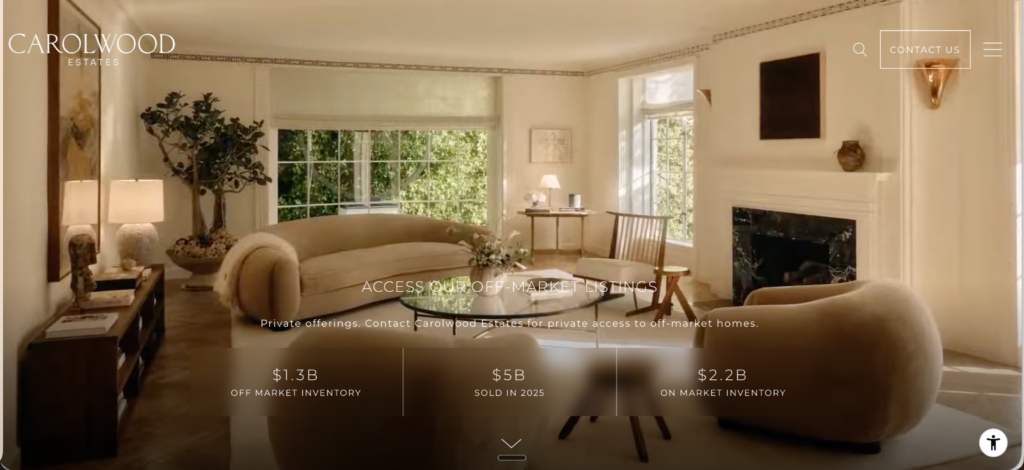
Carolwood Estates uses full-bleed imagery without sacrificing load speed, proof that a visually rich site doesn't have to be a slow one.

The Fridman Group leans on high-resolution photography and video backgrounds with a minimal layout that keeps the focus on the properties.
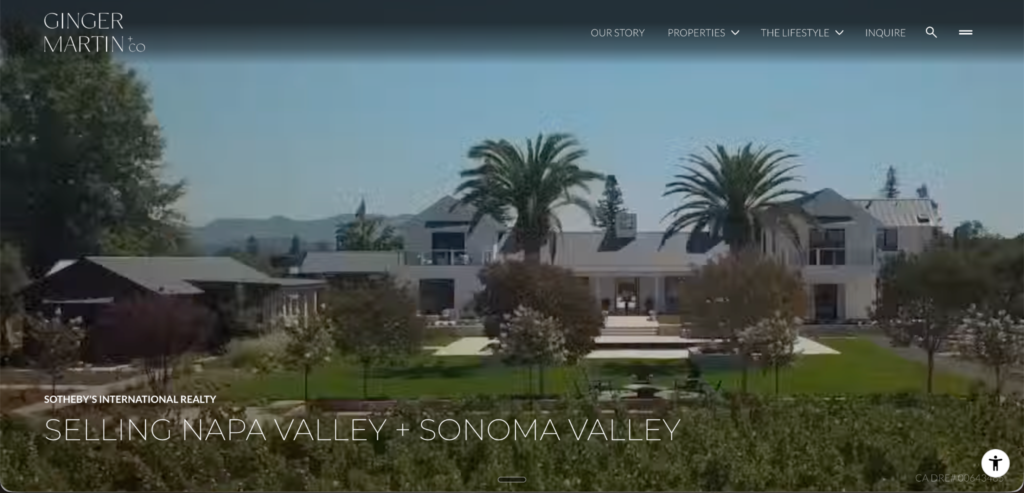
Ginger Martin + Co pairs vibrant lifestyle imagery with an uncluttered design that never feels busy.
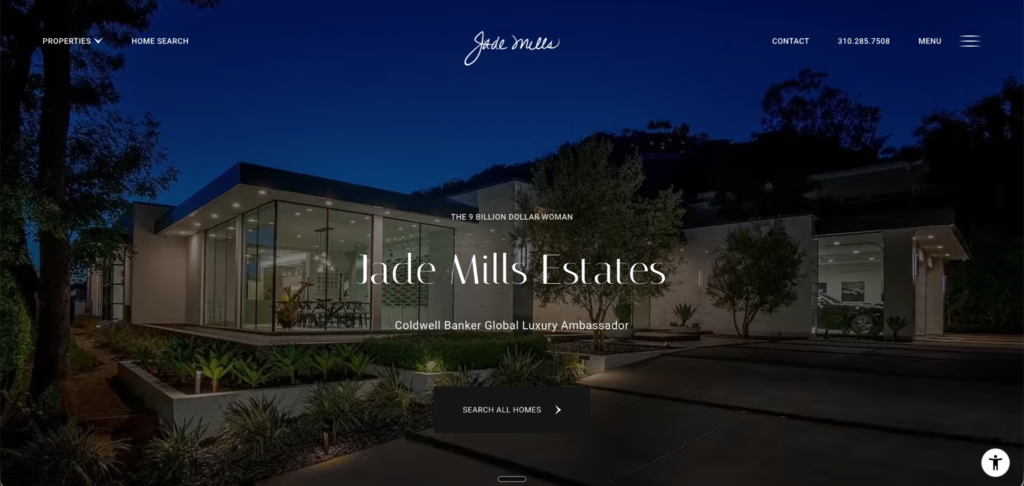
Jade Mills Estates combines cinematic visuals with strong SEO fundamentals, proof the two aren't mutually exclusive.
For more inspiration, our galleries of the best real estate agent websites and case studies are worth a scroll before you finalize your own design direction.
8. Launch, Then Keep Promoting
Publishing your site is the starting gun, not the finish line.
- Share it across every social channel, and keep sharing new content from it instead of posting the homepage link once and moving on.
- Add it to your Google Business Profile and keep that profile active.
- Include it in every email signature and every piece of print marketing, from business cards to open house flyers.
- Post walkthroughs and market updates as video content, and link back to the relevant page on your site.
If ongoing marketing isn't something you want to manage yourself, our real estate marketing services overview covers what to look for in outside help.
FAQs on how to build a real estate website
Ready to grow?
Turn your content into your best lead source
See how Luxury Presence helps agents turn website visits into closed deals