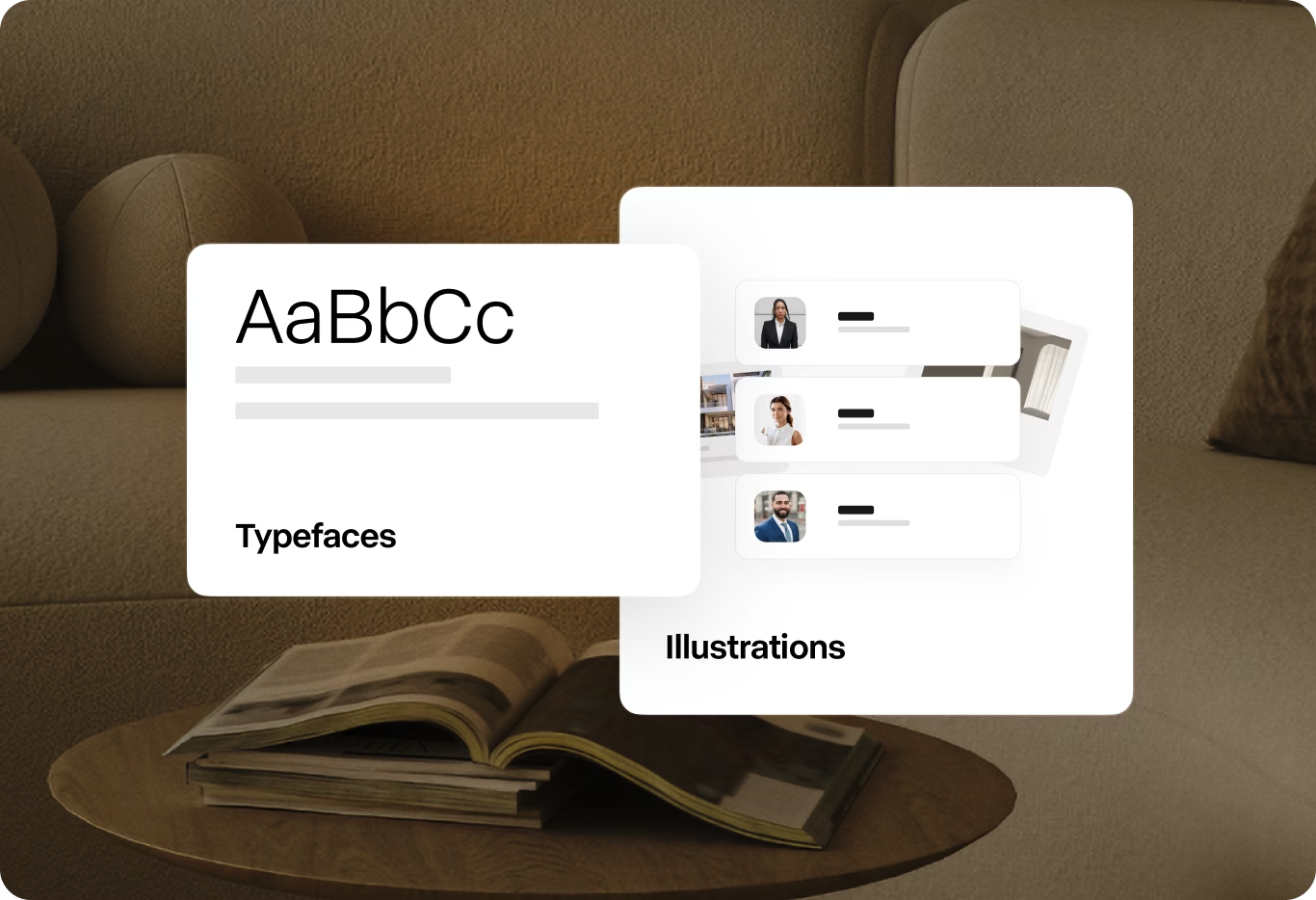
The best real estate marketing materials in 2026 are the ones that work together as a system: a professional website, listing presentations, single property websites, video, social media content, email campaigns, digital ads, print collateral, market reports, client testimonials, press features, neighborhood guides, and a branded mobile app. Each one serves a distinct role in how you attract leads, win listings, and stay visible in your market. The agents who treat these materials as interconnected rather than isolated are the ones closing more deals and building stronger brands.
Luxury agent Dawn McKenna shares her personal rule of thumb: “You should be spending 20% of your income and putting it back into marketing your brand, because your brand is everything.” Whether your number is 20% or something different, the principle holds: your real estate marketing materials are a direct investment in your pipeline, your reputation, and your long-term business.
“Some people think property marketing is only for buyers. In reality, we do a lot of marketing work for the seller’s benefit to show that we’re an expert in presenting their home to the world.”
— Tracy Tutor, Luxury Real Estate Agent, Los Angeles
That reframe matters. Marketing materials are not just about getting eyeballs on a listing. They are how you prove your value to sellers before you ever get the listing agreement signed. This guide breaks down the 13 real estate agent marketing materials that matter most in 2026, with specific guidance on what each one is, why it works, and how to put it into action this week.
Find It Fast
Key takeaways
- Your website is your highest-return marketing asset. Agents with branded, search-visible sites generate significantly more qualified leads than those relying on brokerage templates.
- Video, social media, and email work best as a connected system. Produce long-form video first, then repurpose it across platforms and email campaigns.
- Listing presentations, single property websites, and market reports are the materials that win business directly. Prioritize these for every active listing.
- Print materials still carry weight for high-value and hyper-local markets. Pair them with QR (Quick Response) codes to bridge offline touchpoints to your digital presence.
- Your marketing mix should shift based on market conditions. Seller’s markets demand speed and visibility. Buyer’s markets demand trust and proof.
- Every marketing material should feed into a CRM (Customer Relationship Management) system so no lead goes untracked and no client relationship goes cold.
1. Professional website: your digital HQ
In 2026, your website is the first place a prospective client goes to evaluate whether you are worth a conversation. A templated brokerage page no longer clears that bar. Your site needs to function as both a brand statement and a lead-generation engine, with MLS (Multiple Listing Service)-integrated listings, intuitive navigation, and a fast mobile experience that keeps visitors engaged. Add usability features like interactive neighborhood maps, high-resolution imagery, and strategically placed calls to action. The goal is to make it easy for every visitor to take the next step, whether that is scheduling a call, saving a listing, or downloading a market report. The numbers back this up. Arizona team leader Shannon Gillette saw a 2.6x increase in website traffic, nearly 2,000 leads generated in nine months, and a $4.3 million closed transaction sourced directly from her site after investing in a branded web presence (Luxury Presence Case Study: Shannon Gillette, 2025). Her site also ranked for 2,229 non-branded keywords in the top 10, meaning buyers and sellers found her through organic search, not just referrals. Beverly Hills luxury agent Josh Flagg puts it plainly: “A great website is non-negotiable for those who care about their brand and business.” As he continues, “a substandard website can be a significant red flag to prospects, potentially costing you valuable opportunities.”
Video summary: A walkthrough of a Luxury Presence agent website showing full-screen property photography, interactive map-based search, neighborhood pages, and integrated lead capture forms with scheduling tools.
Elements to prioritize on your website:
- Real-time property data with advanced filtering so buyers can search by price, neighborhood, property type, and lifestyle features
- Integrated lead capture forms and one-click scheduling tools on every listing page
- Conversion tracking to analyze which pages generate the most leads and adjust accordingly
- Fast, mobile-first design that loads in under three seconds on any device
- SEO-focused content pages, including blog posts and neighborhood guides, that attract organic traffic from buyers and sellers searching in your market
2. Branded mobile app: keep clients in your ecosystem
Video summary: A demonstration of a Luxury Presence branded mobile app featuring MLS-integrated property search, in-app messaging between agent and client, push notification alerts for new listings, and custom branding that matches the agent’s website.
A branded mobile app turns every client interaction into an extension of your brand. It gives buyers and sellers a direct way to browse listings, schedule showings, and communicate with you, all within a beautifully designed, agent-branded experience. When clients use your app, they stay in your ecosystem rather than browsing third-party platforms where competitor ads and agent profiles compete for their attention. A branded app creates a direct channel between you and your clients, reinforcing your role as their go-to resource for everything related to their home search or sale.
Features that make a branded app worth the investment:
- Real-time MLS-integrated property search with saved searches and favorites
- In-app messaging for direct client communication, replacing scattered text threads
- Push notifications for new listings, price changes, and showing reminders
- Custom design that matches your website and brand identity so clients experience one consistent look across every touchpoint
3. Listing presentations: data-driven and specific to each client
A listing presentation is more than a sales pitch. It is proof of your process, your market knowledge, and your ability to get results. The strongest presentations combine local market data with a clear, step-by-step marketing plan that shows the seller exactly how you will attract buyers to their home. Use interactive digital presentations that bring your process to life. Include neighborhood comps, recent sales data, and a detailed timeline for how you will market the property from pre-launch through closing. Show past results with specific metrics and visuals, not just words.
“When prospects understand how you market a home, from the initial photos and videos to the open houses and ad campaigns, they’re that much more likely to trust your expertise.”
— Bally Khehra, Luxury Real Estate Agent, Vancouver
That is the standard your presentation needs to meet. As Beverly Hills agent Jade Mills explains: “Your clients want to feel like they are the most important people in your life. You have to make them feel like you are going to live and breathe their listing.”
To make your listing presentations stand out:
- Build custom slides for each property and client, never use the same deck twice without tailoring it
- Use high-quality visuals, including property photography, market charts, and before-and-after staging shots
- Include a clear closing step that makes the next action obvious, such as “Sign the listing agreement today and we launch pre-marketing on Monday”
- Show your marketing plan in detail: which platforms you will use, what content you will create, and how you will track results
4. Single property websites: showcase listings with full control
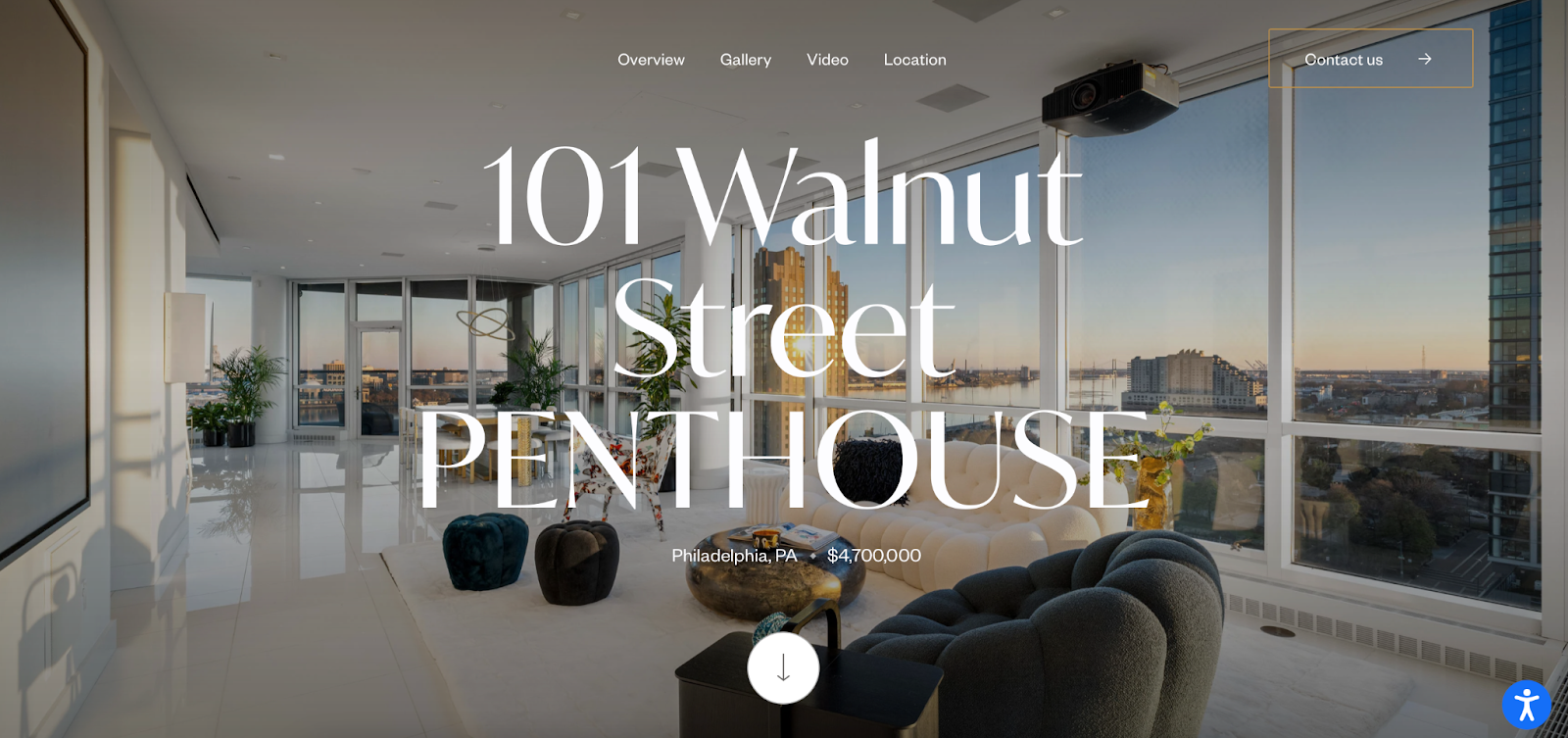
A single property website, a standalone site dedicated to marketing one listing, creates a distraction-free space to showcase a home. Unlike MLS listings or third-party portals, these sites are fully branded and designed to highlight every detail of a property, from photography and video tours to floor plans and neighborhood context. For higher-value listings in particular, single property sites allow you to craft a custom narrative around the home. You can emphasize its standout features, highlight the neighborhood lifestyle, and tell a story that resonates with the right buyer. By controlling the environment, you ensure that every visitor is focused solely on that property and your brand.
What to include on a single property website:
- Full-screen, high-resolution photography and video tours that load quickly on mobile
- Interactive floor plans that let buyers explore the layout room by room
- Detailed neighborhood and lifestyle sections covering schools, dining, parks, and commute times
- Lead capture forms and scheduling requests tied directly to your CRM
- A custom domain name (e.g., 123MainStreet.com) that makes sharing easy across email, ads, and social media
Promote your single property websites everywhere. Include them in email campaigns, feature them in digital ads, and share them across social media to drive traffic. Use these sites as the centerpiece of your listing marketing to capture qualified leads and demonstrate to sellers that you market their home at the highest level.
5. Social media content in 2026: grow your brand with purpose
In 2026, social media remains one of the fastest-growing channels for agent visibility, with short-form video continuing to dominate organic reach across Instagram, TikTok, and YouTube Shorts. But posting without a plan is a waste of time. Choose two or three platforms where your ideal audience spends the most time and focus your efforts there. Develop a content calendar to stay consistent. Share a mix of property highlights, market updates, behind-the-scenes moments, and lifestyle content that reflects the communities you serve. Use platform analytics to track what performs and adjust your mix monthly. Los Angeles luxury agent Ben Belack explains how YouTube serves as the hub for his entire approach: “Everything starts with YouTube because YouTube content can be made smaller and repurposed. A single well-produced video can fuel content for Instagram, TikTok, and other platforms.” That one-to-many approach keeps your presence strong without requiring you to create new content from scratch every day.
Real estate social media marketing essentials:
- Post three to five times per week with a branded look and consistent visual identity
- Repurpose long-form videos into short clips, carousels, and stories to get more mileage from every piece of content
- Use scheduling and analytics tools to batch content creation and measure engagement weekly
- Maintain brand consistency across platforms so your colors, fonts, and tone are recognizable everywhere
6. Video in 2026: show, don’t tell
As of 2026, video is the highest-engagement content format across every major platform agents use. It captures attention, builds familiarity, and showcases your brand’s personality in ways that static images and text cannot match. Ben Belack describes video as foundational: “Video is no longer optional for agents who want to compete at scale. It’s a branding tool, but even more importantly, it’s a performance lever.” Create property videos that combine interior tours, drone footage, and neighborhood lifestyle shots. Short clips of 30 to 60 seconds work well for social media feeds. Full-length tours of three to five minutes are best suited for your website and YouTube channel.
Video strategy for real estate agents:
- Invest in professional production for brand introduction videos and high-value listing tours
- Repurpose every long-form video into at least three shorter clips for Instagram Reels, TikTok, and YouTube Shorts
- Include a clear call to action in every video, such as “Schedule a private showing” or “Visit the property website”
- Publish at least two videos per month to build a library that compounds in search visibility over time
7. Email: stay connected and relevant
Email marketing for real estate agents remains one of the most reliable channels for nurturing leads and maintaining client relationships. With segmentation and automation, you can deliver relevant messages at scale without losing the personal touch that makes clients feel valued. Top-producing agent Chirag Shah believes most real estate newsletters miss the mark entirely: “I bought a house. I don’t care about your open house. I don’t care about ‘just listed.’ And the worst email to send is price reduction.” Instead, he advises, “Talk about the things that are important to them, not the things that I want to talk about.” Shah recommends using CRM tags and AI (Artificial Intelligence) tools to segment your list by client type and stage. A young family might receive emails about local weekend activities and school ratings. Empty nesters get insights on downsizing trends and market conditions in their area. Automation makes this segmentation practical by triggering the right message at the right time: following up after an open house, checking in on a home purchase anniversary, or nurturing new leads through educational content. Real estate email templates built for these specific moments save hours of writing time while keeping your communication consistent.
Email marketing for real estate: what to get right
- Keep designs clean and mobile-friendly, with a single clear call to action per email
- Track open and click-through rates weekly and adjust subject lines, send times, and content based on what performs
- Add interactive elements like embedded video thumbnails or one-click scheduling links to increase engagement
- Send at least two emails per month to your full list and additional targeted messages to active buyer and seller segments
8. Digital ads: targeted, trackable results
In 2026, digital advertising tools give agents the ability to target buyers by income bracket, search history, and geographic radius with greater precision than ever before. Whether you are promoting a new listing or retargeting website visitors who browsed but did not inquire, real estate advertising keeps your brand in front of the right prospects at the right time. Define your campaign goals before you spend a dollar. Create dedicated landing pages for each campaign so traffic goes to a focused destination, not your homepage. Monitor performance weekly and reallocate budget toward the ads that generate the lowest cost per lead. Arizona team leader Shannon Gillette explains how she thinks about targeting: “The cool thing with ads is you can really fine-tune them. We always like to ask ourselves who is the ideal buyer for this property, what are the things they’re searching?” She gives a specific example: “We listed a home once with its own airplane hangar. That home is going to probably be sold to a private pilot that has their own plane, or maybe a car collector, or maybe somebody that has an RV. You can literally run these ads based upon somebody’s internet search history.”
For strong real estate advertising performance:
- Run A/B tests on ad creative and copy, testing at least two variations per campaign before scaling the winner
- Pair every ad with a high-converting landing page that includes a lead capture form and a single clear next step
- Monitor cost per lead, click-through rate, and conversion rate weekly, and pause underperforming campaigns within 14 days
- Use retargeting campaigns to stay visible to prospects who visited your website or single property sites but did not convert
9. Print materials: make it memorable
While digital marketing dominates, print materials still carry weight, especially for agents working in high-value markets and hyper-local farming areas. The key is to pair high-quality design with digital integrations that drive traffic back to your online presence. Business cards, brochures, and postcards should be visually striking and consistent with your brand identity. Combine them with QR codes or NFC (Near Field Communication) tags to create a bridge between offline and online marketing. A postcard with a QR code linking to a single property website turns a piece of mail into a lead capture tool. Or think creatively with your branded materials like Tricia Lee does: “I’m actually having lip balms made to match my website. And I call these business bombs. They have my phone number there and my website on them. Instead of a business card, I give out a business balm. We all have chapped lips and everybody needs my phone number.”
Core print pieces to invest in:
- Business cards with a QR code linking directly to your website or a featured listing
- Brochures and flyers for open houses and listing presentations, printed on heavy stock with professional photography
- Postcards targeting specific neighborhoods or timed to seasonal market updates
- Branded real estate signs with modern, custom designs that reinforce your visual identity at every listing
10. Market reports: share data that builds authority
Clients want to understand the market before making decisions. Regular market reports position you as the source they turn to for reliable, local insights rather than generic national headlines. Create reports that break down pricing trends, days on market, buyer demand, and neighborhood-level activity. Use clean visuals like charts and infographics to make the data easy to scan. Share these reports via email, your website, and client consultations.
How to get the most from your market reports:
- Publish monthly or quarterly updates on a consistent schedule so your audience knows when to expect them
- Include specific takeaways, such as “Median home prices in [neighborhood] rose 4% quarter over quarter, making this a strong window for sellers to list”
- Make reports downloadable behind a lead capture form to grow your email list
- Repurpose key data points into social media graphics and email subject lines to drive traffic back to the full report
New York luxury agent Frances Katzen explains why this consistency matters: “You need to be in touch with your clients all the time. It’s that constant presence that makes them feel completely looked after.” Delivering valuable market insights on a regular cadence is one of the most direct ways to maintain that presence.
11. Client testimonials: build trust with proof
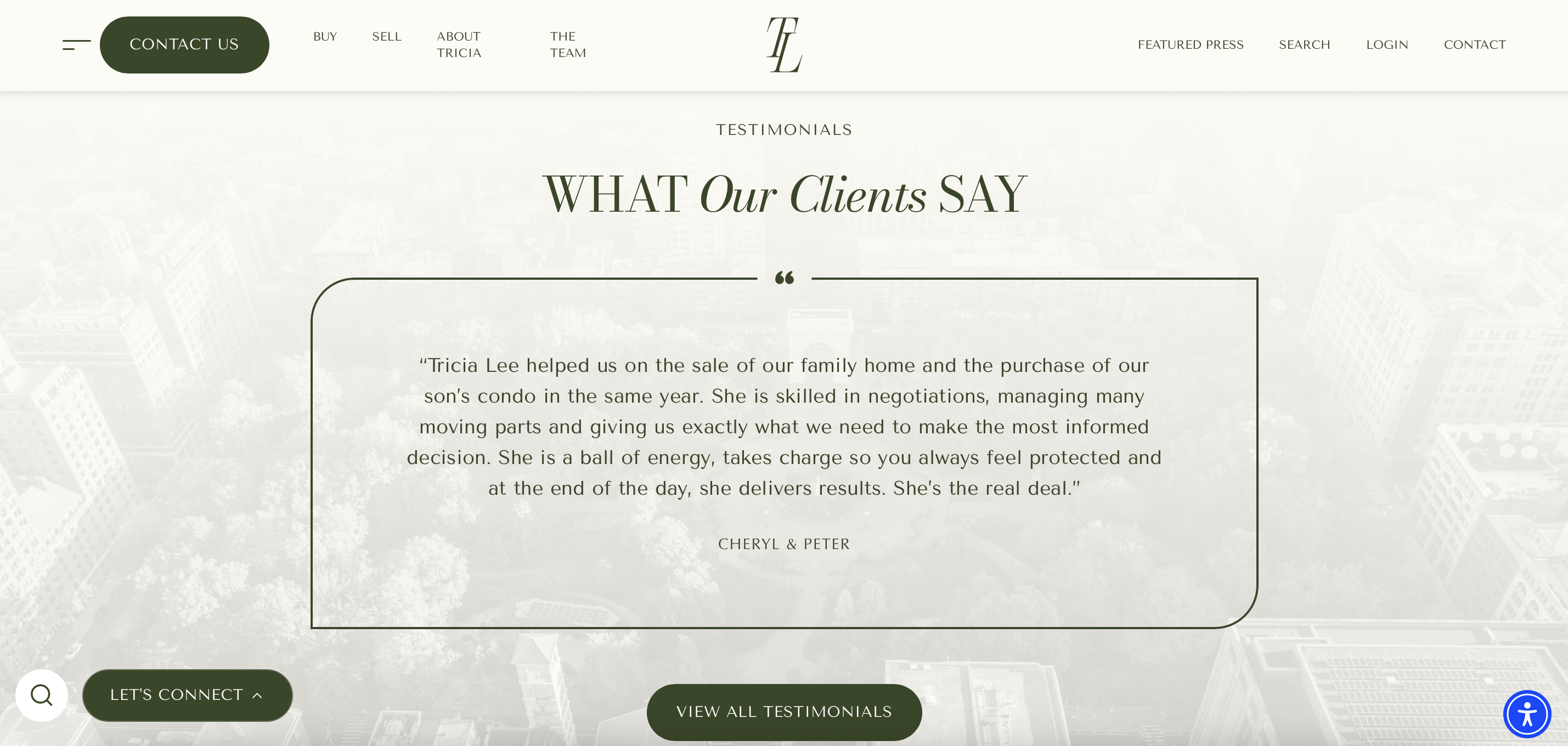
Testimonials are one of the most persuasive real estate marketing materials you can have. They give prospects confidence that you deliver results, and they do the selling for you through social proof rather than self-promotion. New York luxury agent Matt Breitenbach emphasizes the importance of follow-up and relationships, which ultimately generate the positive feedback that powers strong testimonials: “Relationships are everything. Business is nothing more than people, right? Especially in a real estate world.” These relationships become the social proof that does the selling for you. Collect testimonials within 48 hours of a successful closing, while the client’s experience is still fresh. Video testimonials are especially compelling because they capture emotion and authenticity in a way that written reviews cannot.
Where to showcase testimonials for maximum impact:
- Your website home page and individual listing pages
- Social media highlight reels and pinned posts
- Listing presentations, both digital and printed versions
- Email signatures and drip campaign footers
12. Press features: amplify your reputation

Press coverage elevates your brand and positions you as a recognized voice in your market. Build relationships with local journalists and pitch relevant stories about notable listings, market trends, or community projects you are involved in. As South Florida luxury agent Holly Meyer Lucas shares: “Getting on your local news station is one of the most impactful, powerful things you can do. They’re always looking for real estate takeaways.”
Ways to get more value from press features:
- Share articles on social media and in email newsletters the same week they publish
- Add “As Featured In” badges or excerpts to your listing presentations and website bio page
- Include press mentions in follow-up emails to prospects as third-party validation of your market knowledge
- Pitch one story per quarter to a local outlet, timed to seasonal market shifts or notable transactions
Press features create third-party validation that strengthens every other marketing material in your system.
13. Neighborhood guides: become the local expert
Neighborhood guides help clients get to know an area and envision their life there. They also establish you as a hyper-local resource with insider knowledge, a role that Tricia Lee believes is non-negotiable for long-term success. “People want to work with someone who truly knows their community. Being the local expert isn’t just about selling homes, it’s about understanding the schools, the small businesses, the culture, and what makes a neighborhood unique.” Digital guides should be dynamic and interactive, featuring clickable maps, embedded videos, and curated local highlights that bring a neighborhood to life. Printed versions should feel substantial, with design and paper quality that reflect the caliber of your brand.
Ideas for effective neighborhood guides:
- Highlight schools, parks, restaurants, and local attractions with specific names and addresses
- Update quarterly to keep information current and give you a reason to re-share
- Use guides as lead magnets to grow your email list, gating the downloadable version behind a simple form
- Include a section on recent market activity in the neighborhood, such as average sale price and days on market, to add data value alongside lifestyle content
Aligning real estate marketing materials with market strategy and competitive positioning
Marketing for real estate agents is about deploying the right materials at the right time. Every market has its own dynamics shaped by property values, regional demographics, and economic cycles. By understanding these factors and your competition, you can create a marketing plan that is not only polished but strategically aligned to your specific market conditions in 2026.
Price point strategy: tailor by property value
The marketing approach for a multi-million-dollar estate should be very different from an entry-level home. Aligning your materials to the property’s value ensures both relevance and impact.
| Price tier | Focus | When to use | Best materials |
| High-value homes | Create exclusivity and a high-touch experience | For listings where buyers expect premium service and personalization | Single property websites, high-production video tours, premium print materials, branded mobile app |
| Mid-tier homes | Highlight value, family lifestyle, and ease of process | For move-up buyers looking for convenience and clear information | Digital ads, neighborhood guides, data-driven listing presentations, segmented email campaigns |
| Entry-level homes | Build trust and provide resources for first-time buyers | In price-sensitive markets where buyers need education and step-by-step support | Social media content, market reports, website resources and blog content, open house brochures and flyers |
Regional considerations: match the market’s culture
Real estate digital marketing is hyper-local. The strategies that work in one region may not resonate in another. Consider the culture, demographics, and lifestyle of your target audience. The following are generalizations but useful starting points for understanding your market.
Urban markets
- Key traits: Tech-savvy, fast-paced buyers, often younger and mobile-first
- Best approaches: Mobile-friendly tools like branded apps, video marketing, social media storytelling, and targeted digital ads
Suburban markets
- Key traits: Family-driven, community-oriented, with a mix of digital and personal touchpoints
- Best approaches: Neighborhood guides, segmented email campaigns, and hybrid print-plus-digital strategies
Rural markets
- Key traits: Relationship-driven communities with slower adoption of digital tools
- Best approaches: Print marketing, detailed market reports, and segmented email campaigns that foster trust over time
Market cycle timing: adjust tactics based on conditions
Real estate markets move through cycles. Understanding where you are in the cycle helps you prioritize the right materials and keep your marketing spend efficient.
Seller’s market
- Goal: Speed and maximum exposure
- Emphasis: Digital ads for rapid visibility, single property websites for standout listings, mobile app engagement for fast communication, social media campaigns to create buzz
Balanced market
- Goal: Educate and guide both buyers and sellers
- Emphasis: Market reports with specific insights, data-driven listing presentations, email campaigns to nurture leads and keep clients informed
Buyer’s market
- Goal: Build confidence and justify value
- Emphasis: Client testimonials to provide proof of results, premium print pieces to stand out, neighborhood guides to help buyers feel confident in their choices
Bringing it all together
Once you have assessed your market, audience, and competitors, you can deploy your realtor marketing materials with intention:
- High-value listing in a seller’s market? Single property website plus digital ads for rapid exposure.
- Mid-tier home in a suburban market? Neighborhood guide plus hybrid print campaign to connect with families.
- Slower buyer’s market? Market reports plus testimonials to build confidence and credibility.
The most successful agents treat marketing as a dynamic system, not a static checklist. By continuously analyzing your environment and adapting your mix, you stay relevant, competitive, and trusted in any market condition.
Build a cohesive, modern marketing strategy
By combining modern digital strategies, elevated print pieces, and relationship-driven experiences, you can create a marketing system that attracts new clients while retaining past ones. Nile Lundgren sums up the mindset that drives success: “I’m going to be fearless with how I post, fearless with how I negotiate, fearless with how I walk into a pitch. Oftentimes, fear stops people from trying. And if you just try, good things end up happening.” The 13 real estate marketing materials in this guide are not a menu to pick one from. They are a system. Your website feeds your ads. Your ads drive traffic to your single property sites. Your single property sites capture leads that flow into your CRM. Your CRM triggers email campaigns that nurture those leads over time. Your social media content keeps you visible between transactions. And your listing presentations, market reports, testimonials, and press features give you the credibility to win the next listing. Build the system. Run it consistently. Adjust it based on what the data tells you. That is how marketing for realtors works in 2026.
FAQ: real estate marketing materials
Expert website design services
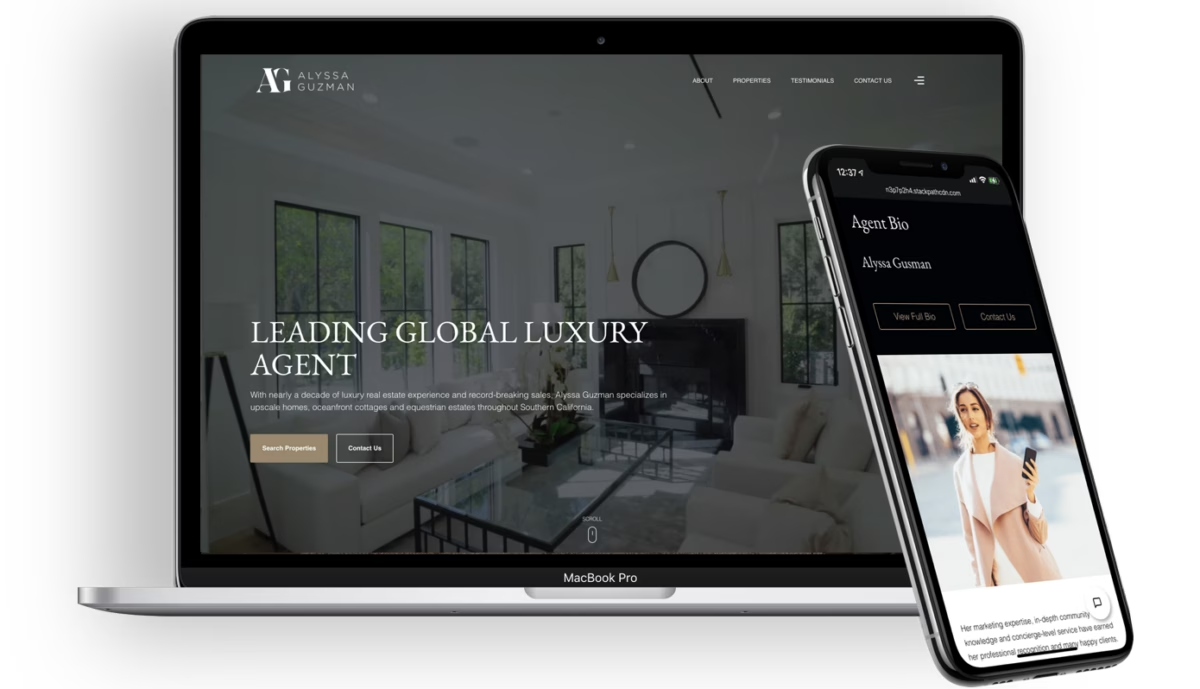
Every day, Luxury Presence creates and manages real estate websites for some of the biggest agents, teams, and brokerages in the country. Learn how we can transform your online presence.
About the author

Marketing Manager
Kate Evans is a content marketing strategist at Luxury Presence, the leading growth platform for high-performing real estate professionals. She develops data-driven editorial content and supports SEO strategy and brand voice frameworks that help agents attract qualified leads and establish market authority. Her published work covers topics including CRM strategy, social media marketing, and digital growth, supporting thousands of agents in scaling their businesses through modern marketing.